Severity of Cholecystitis and Gallstone Size Association
Published in The Journal of Clinical Medicine
Akbar Farooqui ✉
Akbar FarooquiCorresponding author More articles by this author →
Published
Abstract
ObjectiveTo determine the association between severity of cholecystitis and gallstone size. Study Design: Cross-sectional study. Place and Duration of Study: Department of Surgery, Combined Military Hospital, Rawalpindi, from 22nd August 2024 to 21st September 2024.
MethodologyThis study utilized a cross-sectional design to explore the correlation between severity of cholecystitis as assessed by the Parkland grading system and gallstone size, following Ethics Review Board approval. The sample included 67 respondents diagnosed with cholecystitis who underwent laparoscopic cholecystectomy during the study period after obtaining written consent. Data on gallstone size and Parkland grading scores were collected. Gallstone diameter was measured using vernier callipers, while Parkland grading was assessed using a clinical grading system. Gallstone size served as the dependent variable, and Parkland grading was the independent variable. Quantitative analysis was performed using SPSS, with simple linear regression to evaluate the relationship. The model’s compatibility was assessed using R-squared values, with t-tests and p-values for predictors. An ANOVA test determined the overall significance of the regression model.
ResultsThe ANOVA test confirmed the regression model’s significance (F = 18.101, p = 0.001), indicating that Parkland grading is associated with gallstone size, where higher grades correspond to larger stone sizes.
ConclusionA significant positive correlation was observed between Parkland grading score and Gallstone size.
1 Introduction#
Gallstones are a common pathophysiological condition affecting millions globally[1,2]. These rigid formations develop within the gallbladder, and their size often dictates the severity of clinical symptoms and the treatment approach required[3,4]. The Parkland grading system is a clinical tool used to assess the severity of conditions associated with gallstones[5]. Cholesterol gallstone disease, a common gastrointestinal disorder, is characterized by the formation of calculi within the gallbladder, which can vary in size and composition[6,7]. Large gallstones are often associated with more severe clinical manifestations, including biliary colic, cholecystitis, and pancreatitis, particularly when they cause obstructions[8].
Understanding the factors that influence gallstone size is critical for anticipating the progression and severity of the disease, as well as for guiding treatment decisions[9].
2 Methodology#
2.1 Study Design#
This was a cross-sectional study conducted to investigate the relationship between the severity of cholecystitis, as assessed by the Parkland grading system, and gallstone size. The study was approved by the Ethics Review Board of Combined Military Hospital Rawalpindi.
2.2 Inclusion and Exclusion Criteria#
2.3 Inclusion Criteria#
Patients aged 18 years and older, diagnosed with acute cholecystitis based on clinical, laboratory, and imaging findings, and having at least one gallstone confirmed via imaging were included. All participants provided informed consent.
2.4 Exclusion Criteria#
Patients with a history of chronic cholecystitis without acute exacerbation, prior cholecystectomy, or other gallbladder conditions (e.g., gallbladder cancer, biliary colic without cholecystitis) were excluded. Individuals with severe comorbidities, such as advanced liver disease or renal failure, as well as pregnant individuals and those unable or unwilling to comply with the study protocols, were also excluded.
2.5 Data Collection#
A total of 67 patients who met the inclusion criteria underwent laparoscopic cholecystectomy at the Department of Surgery between August 22, 2024, and September 21, 2024. The size of the gallstones was measured postoperatively using vernier calipers, recorded in millimeters. The severity of cholecystitis was evaluated using the Parkland grading system, which is based on clinical criteria[10,11]
3 Results#
Quantitative data analysis was conducted using SPSS software. Quantitative variables were represented using mean ± standard deviation (SD). Frequency/percentages of categorical variables were calculated. Simple linear regression was performed to evaluate the association between gallstone size (dependent variable) and Parkland grading (independent variable). Model compatibility was assessed through R-squared and adjusted R-squared values. Predictors were evaluated using t-tests and p-values. An ANOVA test was used to determine the overall significance of the regression model.
3.1 Demographic and Clinical Characteristics of the Study Population#
Table 1
| Characteristic | Data |
|---|---|
| Sample Size (N) | 67 |
| Age Range (years) | 18 - 70 |
| Gender Distribution (male, %) | 50.7 |
| Gender Distribution (female, %) | 49.3 |
| Gallstone Size (mm, Mean ± SD) | 22.64 ± 4.66 |
| Gallstone Size (mm, Min) | 15.11 |
| Gallstone Size (mm, Max) | 31.35 |
| Parkland Grading (Mean ± SD) | 10.50 ± 2.61 |
| Parkland Grading (Min) | 1 |
| Parkland Grading (Max) | 5 |
| Cholesterol Levels (mg/dL, Mean ± SD) | 198.48 ± 16.85 |
| Cholesterol Levels (mg/dL, Min) | 164.58 |
| Cholesterol Levels (mg/dL, Max) | 241.93 |
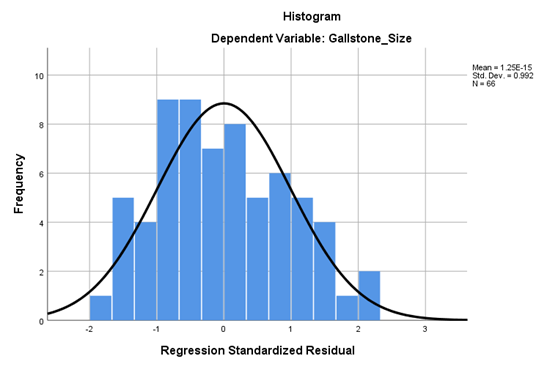
3.2 Histogram of Standardized Residuals#
This histogram shows the distribution of standardized residuals from the regression model evaluating the relationship between Parkland Grading and Gallstone Size. The distribution appears approximately normal, indicating that the assumption of normality of residuals is satisfied for the regression model. This is crucial for validating the results and ensuring that the model fits the data appropriately.
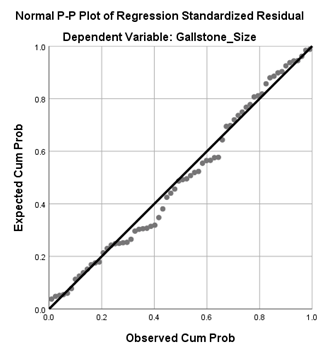
3.3 Scatter Plot of Standardized Residuals#
This scatter plot displays the standardized residuals plotted against the predicted values of gallstone size. The randomness of the scatter suggests that the assumption of homogeneity is met, meaning the variance of residuals is consistent across all levels of the predicted variable. This further supports the validity of the regression analysis and indicates that the model does not suffer from significant issues with heterogeneity.
The regression analysis demonstrated a positive correlation between Parkland Grading and gallstone size. The model summary revealed an R-squared value of 0.325, indicating that Parkland Grading accounts for 32.5% of the variation in gallstone size. The adjusted R-squared value was 0.314, suggesting a good fit for the model. Additionally, the model explained 5% of the variation in gallstone size.
3.4 Model Summary for Regression Analysis#
This table shows the model summary for the regression analysis conducted to evaluate the relationship between Parkland grading and gallstone size. The R-square value indicates that approximately 32.5% of the variability in gallstone size is explained by the Parkland grading score. The adjusted R-square value accounts for the number of predictors in the model.
An ANOVA test confirmed that the regression model was statistically significant (F = 18.101, p = 0.001), confirming that Parkland Grading is significantly associated with gallstone size, with higher grading corresponding to larger stones.
Table 2
| R | R Square | Adjusted R Square | Std. Error of the Estimate |
|---|---|---|---|
| 0.640 | 0.325 | 0.314 | 4.04 |
3.5 ANOVA Results for Regression Model#
This table presents the results of the ANOVA test used to assess the overall significance of the regression model. The F-statistic (18.101) and p-value (0.001) indicate that the relationship between Parkland grading and gallstone size is statistically significant.
The unstandardized coefficient for Parkland Grading was 0.668 ± 0.211, and the t-value was 6.316, which was statistically significant at p < 0.001. This suggests that for every one-unit increase in Parkland Grading, the size of the gallstones increases by 0.668 mm.
Table 3
| Model Value | Sum of Squares | dF | Mean Square | F | Significance (p-value) |
|---|---|---|---|---|---|
| Regression | 1.638 | 1 | 1.638 | 18.101 | 0.001 |
| Residual | 1047.261 | 64 | 16.363 | ||
| Total | 1048.899 | 65 |
3.6 Unstandardized Coefficients for Regression Model#
This table displays the unstandardized and standardized coefficients from the regression model. The unstandardized coefficient for Parkland grading is 0.668, meaning that for each unit increase in Parkland grading, gallstone size increases by 0.668 millimeters. The standardized coefficient (Beta) for Parkland grading is 0.040, reflecting the strength of the association between Parkland grading and gallstone size in standardized terms. The t-values and p-values indicate the statistical significance of these relationships.
Residual analysis indicated that the model met all assumptions, with minimum and maximum predicted values of 21.949 and 22.627, respectively. The residuals ranged from -7.1995 to 9.105. The mean residual value was 0.0005, with a standard deviation of 4.0139. These findings further support the stability of the relationship between Parkland Grading and gallstone size.
Table 4
| Model | Unstandardized Coefficients (B) | Standard Error | Standardized Coefficients (Beta) | t-value | p-value |
|---|---|---|---|---|---|
| Constant | 21.530 | 2.242 | - | 9.604 | 0.000 |
| Parkland Grading | 0.668 | 0.211 | 0.040 | 6.316 | 0.000 |
3.7 Residuals Analysis for Regression Model#
This table presents the residual statistics for the regression model. The residuals range from -7.1995 to 9.105, with a mean close to zero, indicating a good fit for the model. The standardized residuals fall within an acceptable range, further supporting the validity of the model. The standardized predicted values have a mean of 0 and a standard deviation of 1.
Table 5
| Statistic | Minimum | Maximum | Mean | Standard Deviation | N |
|---|---|---|---|---|---|
| Predicted Value | 21.949 | 22.627 | 22.221 | 0.1587 | 66 |
| Residual | -7.1995 | 9.105 | 0.0005 | 4.0139 | 66 |
| Std. Predicted Value | -1.715 | 2.552 | 0.000 | 1.000 | 66 |
| Std. Residual | -1.780 | 2.251 | 0.000 | 0.992 | 66 |
4 Discussion#
The findings of this study indicate a significant positive correlation between the severity of cholecystitis, as assessed by the Parkland grading system, and gallstone size. This is consistent with previous research that has demonstrated similar relationships between gallstone size and disease severity. For instance, Arguello, et al. explored the relationship between the Parkland grading scale and surgical difficulty in laparoscopic cholecystectomy, noting that higher grades were associated with larger gallstones, which contributed to greater surgical challenges[1]. Additionally, Buhavac ,et al. emphasized that larger gallstones often exacerbate clinical manifestations, including obstructive symptoms, thereby increasing the complexity of the treatment process[2].
The study’s regression analysis revealed that 32.5% of the variability in gallstone size could be attributed to cholecystitis severity, underscoring the importance of using the Parkland grading system as a predictor of gallstone size and disease severity. This is in line with findings by Shrestha et al., who validated the Parkland grading system’s role in predicting intraoperative challenges during laparoscopic cholecystectomy[3] . Similarly, Elkbuli, et al. supported the idea that grading systems, such as Parkland, provide vital information for tailoring treatment pathways in cases of acute cholecystitis[4] .
From a clinical perspective, this study reaffirms the utility of the Parkland grading system for guiding treatment decisions. Uçaner, et al. demonstrated the correlation between preoperative ultrasonography findings and the Parkland grading scale in determining the difficulty of laparoscopic cholecystectomy, further supporting the use of this grading system for preoperative planning[5] . The predictive value of the Parkland system helps clinicians anticipate potential complications and plan surgical interventions accordingly, which could improve patient outcomes.
Nevertheless, the study has several limitations that should be acknowledged. The cross-sectional design prevents drawing causal conclusions about the relationship between gallstone size and the severity of cholecystitis. Additionally, the study sample consisted primarily of elderly patients, which may restrict the generalizability of the findings to younger populations. Lee, et al. also pointed out similar limitations in their research, emphasizing the need for larger and more diverse samples to better understand the correlation between gallstone size and cholecystitis severity[6] .
Moreover, this study did not examine other potential factors influencing gallstone size, such as cholesterol levels, which have been previously, by Pinto, et al. identified as key contributors to gallstone formation[7]. Investigating the role of such factors in future research could provide a more comprehensive understanding of the variables contributing to gallstone size and disease severity.
Despite these limitations, the study adds to the growing body of literature that supports the Parkland grading system as a reliable predictor of disease severity in patients with gallstone disease. Serrano-González, et al. emphasized the importance of predictive grading systems in improving surgical outcomes by facilitating better preoperative planning[8] .
Furthermore, Baral, et al. and Schuster, et al. recommend conducting future research with larger cohorts to confirm these findings and to explore the underlying mechanisms that link gallstone size with clinical outcomes[9-10]. These studies could help identify additional risk factors, refine grading systems, and enhance the management of gallstone disease.
In terms of surgical practice, this study underscores the critical role of predictive models like the Parkland grading scale in optimizing patient care. Rangel-Olvera, et al. found that intraoperative complexity, which often correlates with gallstone size, is a key risk factor for conversion to open surgery during laparoscopic cholecystectomy[11]. This further reinforces the relevance of preoperative grading systems in anticipating potential complications and guiding surgical approaches.
In addition, Badawy, et al. highlighted the importance of using sonographic predictors for identifying difficult laparoscopic cholecystectomy cases, noting that larger gallstones often indicate a higher likelihood of complications[12] . Similarly, Tongyoo, et al. proposed a new classification system for assessing surgical difficulty in laparoscopic cholecystectomy, which could complement the Parkland grading scale and provide more nuanced risk assessments[13].
The correlation between gallstone size and surgical complexity has also been explored by Sah, et al., who developed an operative difficulty grading scale specifically for laparoscopic cholecystectomy, showing that larger stones are associated with more challenging surgeries[14]. Similarly, Gupta, et al. have discussed the importance of various grading methods for predicting difficult laparoscopic cholecystectomy and emphasized the value of incorporating multiple clinical factors into preoperative evaluations[15].
Chhoda, et al. noted that managing gallstone disease in the elderly can be particularly challenging due to the higher prevalence of large stones and severe cholecystitis in this population[16]. As such, grading systems like Parkland are especially useful in older patients for predicting disease severity and guiding treatment decisions.
Lastly, Murry, et al. research on managing difficult gallbladders suggests that clinical classification schemes such as Parkland are essential for identifying high-risk cases and improving surgical outcomes[17]. Similarly, Cripps, et al. have highlighted the importance of standardized classification systems for acute cholecystitis to ensure consistent and effective patient care[18].
The limitations of the study include its cross-sectional nature, which restricts conclusions about causality. Furthermore, the study population consisted mainly of elderly patients, which may limit the applicability of the findings to other age groups. Finally, the small sample size could affect the robustness of the conclusions drawn. Future studies should aim to include a larger and more diverse population to validate these findings.
5 Conclusion#
The results of this study suggest that the Parkland grading system is a reliable predictor of gallstone size in patients with cholecystitis. The regression analysis indicated that Parkland grading accounted for 32.5% of the variability in gallstone size, with a statistically significant correlation observed. This relationship underscores the clinical utility of the Parkland grading system, not only in assessing disease severity but also in guiding surgical and medical management.
Future studies should explore the role of additional factors, such as metabolic indicators, in predicting gallstone size and disease progression. Furthermore, expanding the sample size and including a more diverse patient population could provide a broader understanding of the relationship between cholecystitis severity and gallstone size, as recommended by Murry & Babineau and Cripps & Weber.Despite the limitations of the current study, it reinforces the value of the Parkland grading system in predicting the severity of cholecystitis and gallstone size. While future research is needed to address the limitations and explore additional factors, the findings contribute to the evidence supporting the use of grading systems for optimizing the management of gallstone disease.
Declarations
⚖Ethics statement
✎Author contributions
◎Competing interests
Article information
- Published
This article is published open access under the CC BY 4.0 licence. CC BY 4.0 · Corrections policy
References 18#
- 1
Arguello GG, Beltran JB, Cruz IH, et al. Is the Parkland grading scale related to surgical difficulty in laparoscopic cholecystectomy? Int J Res Med Sci. 2022;10(11):2371. https://doi.org/10.18203/2320-6012.ijrms20222831
- 2
Buhavac, M., Elsaadi, A., & Dissanaike, S. (2021). :The bad gallbladder. Surgical Clinics, 101(6), 1053-1065. https://doi.org/10.1016/j.suc.2021.06.004
- 3
Shrestha A, Bhattarai A, Tamrakar KK, et al. Utility of the Parkland grading scale to determine intraoperative challenges during laparoscopic cholecystectomy: A validation study on 206 patients at an academic medical center in Nepal. Patient Saf Surg. 2023;17(1):12. https://doi.org/10.1186/s13037-023-00364-x
- 4
Elkbuli A, Meneses E, Kinslow K, et al. Current grading of gallbladder cholecystitis and management guidelines: Is it sufficient? Ann Med Surg. 2020;60:304-307. https://doi.org/10.1016/j.amsu.2020.10.062
- 5
Uçaner B, Durmuş D, Buldanlı MZ, et al. Correlation between preoperative ultrasonography and Parkland grading scale in patients undergoing laparoscopic cholecystectomy. Indian J Surg. 2024;86(1):160-166. https://doi.org/10.1007/s12262-023-03823-y
- 6
Lee W, Jang JY, Cho JK, et al. Does surgical difficulty relate to the severity of acute cholecystitis? Validation of the Parkland grading scale based on intraoperative findings. Am J Surg. 2020;219(4):637-641. https://doi.org/10.1016/j.amjsurg.2018.12.005
- 7
Pinto P, Pedraza JD, Camacho D, et al. Retrospective validation of the Parkland grading scale in a Latin-American high-volume center. Surg Endosc. 2023;37(7):5190-5195. https://doi.org/10.1007/s00464-023-09946-3
- 8
Serrano-González R, Rivero Y, Hernandez-Velasquez A, et al. Predicting difficulty in laparoscopic cholecystectomies: An evaluation of the Labbad-Vivas score and its correlation with the Parkland grading scale. Cureus. 2024;16(3). https://doi.org/10.7759/cureus.56185
- 9
Baral, S., Chhetri, R. K., & Thapa, N. (2020). :Utilization of an intraoperative grading scale in laparoscopic cholecystectomy: A Nepalese perspective. Gastroenterology Research and Practice, 2020, Article 8954572. https://doi.org/10.1155/2020/8954572
- 10
Schuster KM, O’Connor R, Cripps M, et al. Revision of the AAST grading scale for acute cholecystitis with comparison to physiologic measures of severity. J Trauma Acute Care Surg. 2022;92(4):664-674. https://doi.org/10.1097/TA.0000000000003507
- 11
Rangel-Olvera G, Alanis-Rivera B, Trejo-Suarez J, et al. Intraoperative complexity and risk factors associated with conversion to open surgery during laparoscopic cholecystectomy in eight hospitals in Mexico City. Surg Endosc. 2022;36(12):9321-9328. https://doi.org/10.1007/s00464-022-09206-w
- 12
Badawy, A., Samer, B., & Sabra, T. (2024). :Analysis of the sonographic predictors of difficult laparoscopic cholecystectomy in symptomatic cholelithiasis. Asian Journal of Endoscopic Surgery, 17(2), e13300. https://doi.org/10.1111/ases.13300
- 13
Tongyoo A, Liwattanakun A, Sriussadaporn E, et al. New proposed classification of difficulty in laparoscopic cholecystectomy. J Laparoendosc Adv Surg Tech. 2024;34(5):407-414. https://doi.org/10.1089/lap.2024.0045
- 14
Sah NP, Gupta RK, Awale L, et al. Operative difficulty grading scale for laparoscopic cholecystectomy at a tertiary care hospital in Eastern Nepal. J Kathmandu Med Coll. 2022;11(1):58-67. https://doi.org/10.3126/jkmc.v11i1.45497
- 15
Gupta, N., Hazrah, P., & Anand, G. (2022). :Prediction and grading methods of a difficult laparoscopic cholecystectomy. In Recent Concepts in Minimal Access Surgery: Volume 1 (pp. 83-110). https://doi.org/10.1007/978-981-16-5473-2_4
- 16
Chhoda, A., Mukewar, S. S., & Mahadev, S. (2021). :Managing gallstone disease in the elderly. Clinics in Geriatric Medicine, 37(1), 43-69. https://doi.org/10.1016/j.cger.2020.08.005
- 17
Murry, J., & Babineau, H. (2024). :Management of the difficult gallbladder. Surgical Clinics. https://doi.org/10.1016/j.suc.2024.03.009
- 18
ripps, M. W., & Weber, N. T. (2022). :Classification schemes for acute cholecystitis. Panamerican Journal of Trauma, Critical Care & Emergency Surgery, 11(3), 139-144. https://doi.org/10.5005/jp-journals-10030-1394