Selecting The Trilobed Flap For Distal Nasal Reconstruction After Skin-Cancer Excision: A Systematic Review Of Indications And Outcomes
Frederik Penzien Wainer Mamsen1 ✉
Frederik Penzien Wainer MamsenCorresponding author- 1 † Department of Plastic Surgery and Breast Surgery, Zealand University Hospital, Roskilde, Denmark.
Lukas Kure-Rosenberg1
Lukas Kure-Rosenberg- 1 † Department of Plastic Surgery and Breast Surgery, Zealand University Hospital, Roskilde, Denmark.
Claes Hannibal Kiilerich2
Claes Hannibal Kiilerich- 2 Department of Plastic Surgery and Breast Surgery, Aarhus University Hospital, Aarhus, Denmark.
Taiba Alrasheed1
Taiba Alrasheed- 1 † Department of Plastic Surgery and Breast Surgery, Zealand University Hospital, Roskilde, Denmark.
Jorgen Hesselfeldt1
Jorgen Hesselfeldt- 1 † Department of Plastic Surgery and Breast Surgery, Zealand University Hospital, Roskilde, Denmark.
Show affiliations (2)
- 1† Department of Plastic Surgery and Breast Surgery, Zealand University Hospital, Roskilde, Denmark.
- 2Department of Plastic Surgery and Breast Surgery, Aarhus University Hospital, Aarhus, Denmark.
Published
Abstract
ObjectivesThe trilobed flap is a third-lobe modification of the bilobed flap, but its indications after skin cancer excision remain debated. We systematically reviewed the evidence to define its indications and to quantify its safety.
MethodsMEDLINE/PubMed and Embase were searched from inception to 22 June 2026, supplemented by hand-searching and citation tracking, for studies of trilobed or modified trilobed flaps for nasal reconstruction after skin cancer excision. The primary outcome was the indication for the trilobed flap; secondary outcomes were flap necrosis, pincushioning, alar distortion, and reoperation. Pooled proportions with exact 95% confidence intervals (CIs) were calculated where denominators were available.
ResultsFive studies (one comparative cohort and four case series; 180 trilobed or multilobed reconstructions) were included. The trilobed flap was consistently selected for distal subunits (tip, infratip lobule, soft triangle, distal ala) and for rigid, sebaceous noses with limited donor laxity, where a bilobed flap’s reach was insufficient. In the comparative cohort, trilobed flaps were used significantly more distally than bilobed flaps, with no significant difference in postprocedural events. In series with itemized safety reporting, no flap necrosis or major postoperative events occurred (0/49; 95% CI 0–7.3%). Pincushioning was infrequent and comparable to the bilobed flap.
ConclusionsThe trilobed flap is best suited to small-to-intermediate, partial-thickness distal nasal defects beyond the reliable reach of a bilobed flap that do not warrant an interpolated flap or graft. Reported flap survival is excellent and complications rare, but the evidence is small, retrospective, and heterogeneous; prospective comparative studies with standardized outcome reporting are needed.
1 Introduction#
The nose is the most common site of facial cutaneous malignancy, and the burden of non-melanoma skin cancer (NMSC) continues to rise worldwide[1,2]. To minimize defects following NMSC removal, intraoperative margin assessment (for example, Mohs micrographic surgery) can be performed to maximize histologic margin control while sparing healthy tissue[3]. Reconstruction after tumor excision must restore a complex, three-dimensional, multi-subunit structure[4,5]. Transposition flaps are a workhorse of cutaneous nasal repair. The bilobed flap, described by Esser, refined by Zitelli and later by Cook, recruits laxity from the proximal nasal dorsum and sidewall to resurface tip and alar defects, distributing tension across two lobes and a broad arc of rotation[6-9]. Yet the bilobed flap has limits. As a defect moves distally onto the tip, infratip lobule, or soft triangle, the required arc of rotation increases, and the pivotal restraint, the tethering force at the flap base described by Dzubow, elevates the alar rim and risks nasal distortion[10].
The trilobed flap was introduced by Albertini and Hansen as a logical extension of the bilobed flap design. Adding a third lobe recruits laxity over a wider area, increases the rotational arc, extends the distance from defect to donor tissue recruitment, and decreases pivotal restraint, allowing the transposed flaps to reach the most distal regions of the nose without lifting the alar rim[11]. Despite its conceptual appeal, the trilobed flap is a more complex repair that creates additional incisions and a larger donor footprint. It competes with several established alternatives, among which the dorsal nasal (rotation) flap[12,13], the staged paramedian forehead flap and the staged nasolabial (cheek-to-nose) interpolation flap[14,15], full-thickness skin grafting, and healing by second intention[16], are the most frequent. Surgeons, therefore, face a recurring decision: when does adding a third lobe confer a real advantage, and when is it unnecessary?
Two clinical questions follow. First, which defect- and patient-level features justify selecting a trilobed flap over alternatives? Second, what is its safety profile, specifically regarding flap necrosis, pincushioning, and alar distortion in nasal reconstruction? We addressed both questions through a systematic review and a descriptive synthesis of the dedicated trilobed-flap literature, benchmarked against the broader evidence on nasal reconstruction.
2 Methods#
2.1 Protocol, reporting standard, and review question#
The review followed the Preferred Reporting Items for Systematic Reviews and Meta-Analyses (PRISMA) 2020 statement[17]. A protocol outlining eligibility criteria, outcomes, and an analysis plan was defined a priori. The review was not prospectively registered. The question was framed using Population, Intervention, Comparator, Outcome (PICO) terms (Table 1).
Table 1 PICO framework defining study eligibility.
| Element | Definition |
|---|---|
| Population | Patients undergoing nasal reconstruction after excision of non-melanoma skin cancer, including Mohs micrographic surgery defects. |
| Intervention | Trilobed transposition flap or explicitly described modification, including modified-angle or extended-base designs. |
| Comparator | Bilobed flap, dorsal nasal flap, interpolated forehead/melolabial flap, full-thickness skin grafting, or second-intention healing where reported. |
| Primary outcome | Indication for selecting the trilobed flap, based on defect subunit, geometry, depth, tissue laxity, and free-margin risk. |
| Secondary outcomes | Flap necrosis, pincushioning/trapdoor deformity, free-margin distortion, revision/reoperation, and aesthetic/ scar assessment. |
PICO, Population, Intervention, Comparator, Outcome.
2.2 Eligibility criteria#
We included original studies (comparative cohorts, case series, and technique studies with outcome data) in which the trilobed flap was used for nasal reconstruction after cutaneous oncologic resection. We excluded single-image case reports without outcome data, reviews and book chapters used only for background, studies of non-oncologic or traumatic defects without separable data, and reconstructions outside the nose. Only English-language full reports were extractable for synthesis.
2.3 Information sources and search#
Bibliographic searches were conducted in MEDLINE/PubMed and Embase (Ovid) from inception to 22 June 2026. Reference lists of included studies and relevant reviews were searched to identify additional reports. No date restrictions were applied. The full search strings for each source are provided in Supplementary Material 1.
2.4 Study selection and data extraction#
Search results were imported into Zotero, and duplicates were removed. Records were screened by title and abstract, then at full text, against the eligibility criteria, independently by two reviewers (F.P.W.M. and L.K.R.). Disagreements were resolved by consensus or by consultation with a third reviewer. From each included study, we extracted the design, period, number of trilobed reconstructions, defect site and size, tumor and surgical context, stated indication for flap choice, follow-up, complications by type, reoperation, and aesthetic outcome measures. When a study combined bilobed and trilobed (“multilobed”) cases, we recorded the combined denominator and flagged it as non-separable.
2.5 Outcomes and definitions#
Flap necrosis was defined as total or partial loss of flap tissue. Pincushioning (trapdoor deformity) was defined as convex bulging of the flap due to circumferential scar contracture. Free-margin distortion was defined as alar rim elevation, retraction, or notching. Reoperation included scar revision, dermabrasion, intralesional steroid, or take-back. The primary indication outcome was synthesized from the explicit selection rationale and the anatomical distribution of cases.
2.6 Risk-of-bias assessment#
Because all included studies were non-randomized, methodological quality was appraised using the Joanna Briggs Institute critical-appraisal tools for case series and cohort studies[18], with attention to consecutive enrollment, completeness of follow-up, objectivity of outcome ascertainment, and completeness of reporting. The appraisal was descriptive rather than score-based, given the small number of studies.
2.7 Synthesis methods#
We pre-specified that a random-effects proportion meta-analysis would be performed only when at least five studies reported the same outcome and provided extractable event-level denominators. Because the dedicated trilobed literature is small and several series reported zero events, formal random-effects pooling with forest plots was not statistically appropriate for most outcomes. We therefore report exact binomial (Clopper–Pearson) 95% confidence intervals (CIs) for pooled raw proportions where denominators were available[19], present a structured narrative synthesis for the remaining outcomes, and benchmark our estimates against a 2025 systematic review and meta-analysis of 1362 distal-nasal-reconstruction patients[20].
2.8 Use of artificial intelligence#
An AI assistant was used to support data organization and language editing of the manuscript; it was not used for study selection, data extraction, or statistical analysis. All citations were verified against their primary source records, and the authors take full responsibility for the integrity, accuracy, and originality of the final manuscript.
3 Results#
3.1 Study selection#
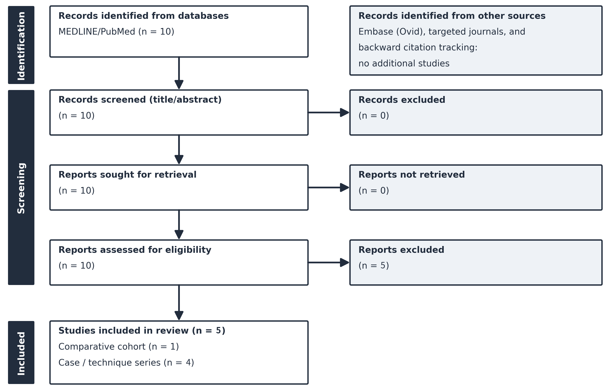
The database searches and citation tracking identified 10 unique records after deduplication; all 10 were retained after title and abstract screening and assessed at full text, and 5 were excluded. Five dedicated trilobed-flap studies met the inclusion criteria: one comparative cohort study, three single-technique case series, and one two-institution series of multilobed (bilobed and trilobed) flap cases. Together, they describe 180 trilobed or multilobed reconstructions. The study identification and selection process is summarized in the PRISMA 2020 flow diagram (Figure 1).
3.2 Characteristics of included studies#
The included studies span 2010–2023 and originate from dermatologic and plastic surgical units in the United States and Japan. All studies addressed distal nasal defects following skin cancer resection, most commonly basal cell carcinoma treated with Mohs micrographic surgery. Their characteristics are summarized in Table 2.
Table 2 Characteristics of the five included studies.
| Study (year) | Design | Reconstructions | Main site | Assessment | Key finding |
|---|---|---|---|---|---|
| Albertini and Hansen (2010)[11] | Case series | 31 patients | Distal nose (tip, ala, infratip) | Blinded grading, 3 reviewers | Introduced the flap; median alar symmetry and cosmesis graded excellent. |
| Knackstedt, Lee and Jellinek (2018)[21] | Comparative cohort | 74 trilobed (vs 111 bilobed) | Tip / infratip | 7-year chart review | Trilobed used significantly more distally; no significant difference in complications or trapdoor vs bilobed. |
| Wang et al. (2018)[24] | Case series (modified) | 26 patients (21 long-term) | Distal nose | 2 masked raters | Unequal external interlobe angles avoid valve compression/ ectropion; excellent alar symmetry. |
| Stiff et al. (2022)[22] | Two-institution series | 34 multilobed (bi + tri) | Intermediate/large (mean 1.8 cm) | SCAR + POSAS, min 5 weeks | No major postoperative events; favorable scar scores; scar revision in 9. |
| Asaka et al. (2023)[23] | Case series (modified) | 15 patients | Distal nose | Mean 15.6 months | Extended base/tip design; all flaps survived; no complications. |
bi + tri, bilobed and trilobed flaps combined (not separable); POSAS, Patient and Observer Scar Assessment Scale; SCAR, Scar Cosmesis Assessment and Rating scale.
3.3 Primary outcome: when the trilobed flap is indicated#
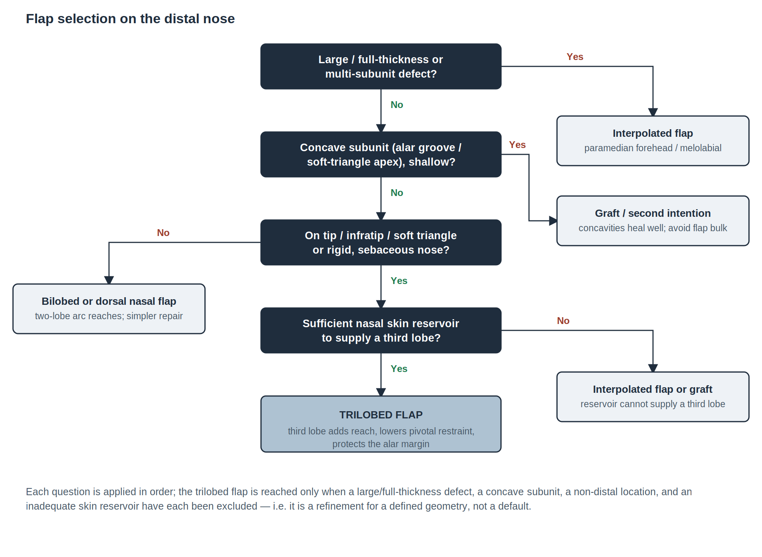
Across studies, the rationale for choosing a trilobed flap converged on a consistent set of defect- and patient-level features. The unifying theme is geometric. The third lobe is added when a bilobed flap cannot reach a distal defect or cannot do so without unacceptable tension or free-margin movement. The most direct evidence comes from a comparative cohort of 185 reconstructions, in which trilobed flaps were used significantly more often on the nasal tip and infratip, whereas bilobed flaps predominated on the inferior dorsum and sidewall. The two flaps did not differ significantly in postprocedural events, indicating that the trilobed flap’s more distal application and additional lobe did not incur a measurable safety cost[21]. The mechanistic basis is the increased arc of rotation and reduced pivotal restraint contributed by the third lobe, which lowers the upward vector that would otherwise elevate the alar margin[10,11]. Several authors specifically recommend the trilobed flap for rigid, sebaceous noses or when the donor pinch test demonstrates reduced laxity, because the second lobe in a bilobed flap cannot recruit enough mobile skin without distorting adjacent landmarks[11,21]. Synthesizing the selection rationale and anatomical distribution, the trilobed flap is indicated when all of the following hold: 1) the defect is small-to-intermediate and partial-thickness, 2) it lies on a distal subunit (tip, infratip, soft triangle, or distal ala), 3) a bilobed flap cannot cover it without free-margin distortion, and 4) the nasal skin reservoir is sufficient to supply a third lobe. Conversely, the literature points away from the trilobed flap for very large or full-thickness, multi-subunit defects (favoring other reconstructive options such as the interpolated forehead or nasolabial flaps) (Table 3). A practical decision framework for nasal reconstruction including the appropriate application of the trilobed flap is visualized in the flowchart in Figure 2.
Table 3 Summary of secondary outcomes.
| Outcome | Studies reporting | Pooled / typical estimate | Interpretation |
|---|---|---|---|
| Flap necrosis (total/partial) | All 5 (itemized in ≥2) | 0/49 with itemized reporting (0%, exact 95% CI 0–7.3%); 0% local flaps in benchmark[20] | Complete survival is the norm; trilobed flaps sit at the safest end of the necrosis spectrum. |
| Pincushioning / trapdoor | Comparative cohort + modified series | No significant difference vs bilobed; uncommon[21,24] | Largely technique-dependent; usually managed without reoperation. |
| Free-margin (alar) distortion | All 5 (aesthetic endpoints) | Median alar symmetry graded excellent[11,24] | Margin preservation is the flap’s principal advantage. |
| Reoperation / revision | Comparative cohort + series | Scar revision 9/34 (26%) (multilobed)[22]; 1% local flaps in benchmark[20] | Mostly refinement; true take-back is rare |
CI, confidence interval (Clopper–Pearson exact method). Benchmark values are from the distal nasal reconstruction meta-analysis by Salzano et al.[20].
3.4 Secondary outcome 1: Flap necrosis and complete flap survival#
Flap survival was the most consistently reported safety outcome. In the two series with explicit, itemized safety reporting (the modified trilobed and multilobed cohorts), no flap necrosis or major postoperative events were recorded across 49 reconstructions (pooled raw proportion 0%; exact 95% CI 0–7.3%)[22,23]. This pooled denominator is multilobed-inclusive, as the two-institution series combined bilobed and trilobed cases and did not report a separate trilobed-only count; it should therefore be read as a multilobed safety estimate rather than a trilobed-specific one. The original 31-patient series and the 26-patient modified-angle series likewise reported no flap loss, and the comparative cohort found that complications of any type were rare and statistically indistinguishable between flap types[11,21,24]. These trilobed-specific findings align with the contemporary meta-analytic benchmark. Among 1362 distal-nasal-reconstruction patients, flap or graft necrosis occurred in 0% of local flaps, compared with 2% of regional and 5% of free flaps, confirming that random-pattern local transposition flaps such as the trilobed flap are at the safest end of the necrosis spectrum for nasal reconstruction[20].
3.5 Secondary outcome 2: Pincushioning and trapdoor deformity#
Pincushioning is a recognized tendency of transposition flaps, including bilobed and trilobed flaps, because the curvilinear scar can contract circumferentially around a convex island of tissue[8,9,25]. In the directly comparative cohort, trapdoor deformity was explicitly assessed and found to be no different between bilobed and trilobed flaps[21]. The modified-design series reported no clinically significant pincushioning or contour deformity, which the authors attributed to minimizing inset tension and to design modifications (an extended lobe base and unequal external interlobe angles) that reduce focal contracture and the risk of internal-valve compression or ectropion[23,24]. Taken together, pincushioning after the trilobed flap appears uncommon and is broadly equivalent to that after the bilobed flap, with technique, a tension-free inset, judicious thinning, and accurate lobe geometry as the principal modifiable determinants. When it occurs, it is typically managed with intralesional corticosteroids, massage, or delayed dermabrasion, with surgical revision (for example, peripheral Z-plasties) reserved for marked deformity[25].
3.6 Secondary outcome 3: Free-margin (alar) distortion and aesthetic results#
Preservation of the alar margin is the central design objective of the trilobed flap, and the included studies identified it as the principal advantage. Blinded photographic grading in the original series yielded median alar symmetry and overall cosmesis scores in the excellent range[11], and the modified-angle series similarly recorded excellent alar symmetry, with overall cosmesis rated between excellent and very good[24]. The multilobed two-institution cohort, using validated provider- and patient-rated scar instruments (the Scar Cosmesis Assessment and Rating [SCAR] scale and the Patient and Observer Scar Assessment Scale [POSAS]), reported favorable scores (mean provider SCAR 3.06 on a 0–13 scale; mean patient SCAR 0.07 on a 0–2 scale; mean patient POSAS 10.93 on a 6–60 scale) with no major events[22,26,27].
3.7 Secondary outcome 4: Reoperation and revision#
Unplanned reoperation was rare, but scar revision was common in the two-institution series: it was performed in 9 of 34 multilobed reconstructions (26%; exact 95% CI 13–44%), and no major postoperative events occurred[22]. Other series reported little or no revision surgery[11,23]. For context, the distal nasal reconstruction meta-analysis found revision in 1% of local-flap reconstructions, versus 11% for mixed techniques and 7% across all methods[20].
3.8 Risk of bias#
The evidence base is limited by design. All included studies were retrospective with small sample sizes. Follow-up duration and outcome definitions varied, and complication ascertainment was rarely standardized. Strengths included consecutive enrollment in several series, blinded photographic grading of aesthetic endpoints, and, in two studies, validated scar instruments. Selective reporting and the predominance of single-operator or single-center experience introduce a plausible risk of overly optimistic outcome estimates. These limitations reduce the certainty of the pooled estimates, while the direction of effect remains favorable, with survival and a low complication burden consistent across sources.
4 Discussion#
This review set out to answer a practical question: when to choose a trilobed flap and to characterize its safety after skin cancer excision. The synthesis supports a clear, geometry-driven indication and an encouraging yet modestly evidenced safety profile.
4.1 Principal findings#
The trilobed flap earns its place on the reconstructive ladder at a specific point[28]: small-to-intermediate, partial-thickness defects of the distal nose, particularly the tip and infratip, that extend beyond the reliable reach of a bilobed flap but do not warrant a staged interpolated flap or a graft. The comparative cohort provides the strongest evidence for this niche, showing that trilobed flaps are used significantly more distally than bilobed flaps without a measurable increase in complications[21]. The third lobe’s contribution, greater arc of rotation, and reduced pivotal restraint directly address the failure mode that limits the bilobed flap distally: upward traction on the alar margin[10,11].
4.2 A clinical decision flowchart#
Synthesizing the literature, flap choice for the distal nose can be approached as a sequence of anatomical and tissue questions, summarized in Figure 2. This framework is deliberately conservative. The trilobed flap is a refinement for a defined geometry, not a default. Its additional incisions and larger secondary defect mean that, when a bilobed flap or graft will suffice, the simpler option is usually preferable.
4.3 Comparison with the wider literature#
Our safety findings align with the largest contemporary synthesis of distal nasal reconstruction, which pooled data from 1362 patients and found no necrosis and a 1% revision rate for local flaps, compared with 2% necrosis for regional flaps, 5% for free flaps, and an 11% revision rate for mixed techniques[20]. They are also consistent with classic teaching on transposition-flap design and the aesthetic subunit principle, in which meticulous attention to lobe geometry and a tension-free inset minimizes both pincushioning and free-margin distortion[8,9,29-31]. The convergence of single-technique series, a comparative cohort, and an external meta-analysis lends reasonable confidence that the trilobed flap, in appropriately selected distal defects, is a safe and aesthetically reliable repair.
4.4 Choosing between the trilobed flap and its alternatives#
The clinical value of this review lies less in confirming that the trilobed flap is safe than in clarifying where it should sit among competing reconstructive repairs. Compared with the bilobed flap, the deciding variable is location and tissue rigidity. The comparative cohort shows bilobed flaps migrating to the dorsum and sidewall, and trilobed flaps to the tip and infratip. A defect at or below the tip-defining points, or a rigid sebaceous nose with a poor pinch test, tips the decision toward the third lobe[11,21].
Compared with the dorsal nasal (rotation) flap, which can resurface midline tip defects by rotating the entire dorsal envelope[12,13], the trilobed flap is preferable when the dorsal reservoir is insufficient or when rotating it would blunt the nasofacial sulcus or distort the contralateral side. The trilobed flap localizes the donor footprint to the ipsilateral lower nose. Compared with full-thickness skin grafting and second intention, the trilobed flap wins on color, thickness, and contour match for convex tip skin, where a graft tends to look patched and a granulating wound may contract the margin. Conversely, for shallow defects of concave subunits (the alar groove or soft-triangle apex), a graft or second intention frequently yields a superior result. Adding a flap in these areas has a high risk of undesired bulking[16]. Compared with the two-stage interpolated flaps, the trilobed flap offers single-stage healing with no pedicle division and no interval deformity, which may matter to patients unwilling to accept a multi-week, multi-procedure course. The trade-off is capacity: once a defect becomes large, full-thickness, or crosses several subunits, the nasal skin reservoir cannot safely supply a third lobe, and the interpolated flaps that import distant tissue become the safer and more aesthetic choice[14,20].
Framed this way, the trilobed flap is neither a niche curiosity nor a universal solution: it is the repair that extends single-stage local transposition to its distal-nasal limit, and the surgeon’s task is to recognize when a defect has reached that limit but not yet exceeded it.
4.5 Strengths and limitations#
The principal strength of this review is its focus: by isolating the dedicated trilobed-flap literature and pairing it with a comparative cohort and a large external meta-analysis, it answers a question that broad reconstructive reviews leave implicit. The limitations stem from its evidence base. The dedicated literature is small, retrospective, and heterogeneous. Several series report zero events, precluding meaningful random-effects pooling and producing wide confidence intervals; one cohort combines bilobed and trilobed denominators. Aesthetic outcomes, though often graded by blinded reviewers, rely on nonvalidated scales in most studies. The absence of prospective, head-to-head comparisons against grafting and interpolated flaps means the indication framework is built on anatomical distribution and expert rationale rather than randomized evidence. Finally, the review was not prospectively registered.
4.6 Implications for research#
The field would benefit from prospective, multicenter registries that record defect subunit and size, flap choice, standardized definitions of complications, and validated patient-reported and observer-rated scar outcomes (such as the POSAS and SCAR instruments)[26,27]. Such data would permit a properly powered forest-plot meta-analysis that the current literature cannot support and would allow direct comparison of the trilobed flap against its principal alternatives at matched defect sites.
5 Conclusions#
The trilobed flap is indicated for small-to-intermediate, partial-thickness defects of the distal nose, most clearly the tip and infratip, that extend beyond the reliable reach of a bilobed flap yet do not require an interpolated flap or skin graft. It is especially useful in rigid, sebaceous noses with limited donor-site laxity. When appropriately selected, reported flap survival is excellent, pincushioning is comparable to that of the bilobed flap, and unplanned reoperation is rare, although scar revision was common (26%) in one multilobed series. These conclusions are based on a small, retrospective evidence base and should be confirmed by prospective comparative studies with standardized outcome reporting.
6 Declarations#
Running head: Trilobed flap for nasal reconstruction.
Declarations
⚖Ethics statement
✓Patient consent
€Funding
◎Competing interests
▤Data availability
♥Acknowledgements
Article information
- Published
Copyright © 2026 Frederik Penzien Wainer Mamsen, MD, PhD , This is an open access article distributed under the Creative Commons Attribution License, which permits unrestricted use, distribution, and reproduction in any medium, provided the original work is properly cited. CC BY 4.0 · Corrections policy
References 31#
- 1
Rogers HW, Weinstock MA, Feldman SR, et al. Incidence estimate of nonmelanoma skin cancer (keratinocyte carcinomas) in the U.S. population, 2012. JAMA Dermatol. 2015 Oct;151(10):1081-6.
- 2
Lomas A, Leonardi-Bee J, Bath-Hextall F. A systematic review of worldwide incidence of nonmelanoma skin cancer. Br J Dermatol. 2012 May;166(5):1069-80.
- 3
Connolly SM, Baker DR, Coldiron BM, et al. AAD/ACMS/ ASDSA/ASMS 2012 appropriate use criteria for Mohs micrographic surgery: a report of the American Academy of Dermatology, American College of Mohs Surgery, American Society for Dermatologic Surgery Association, and the American Society for Mohs Surgery. J Am Acad Dermatol. 2012 Oct;67(4):531-50.
- 4
Burget GC, Menick FJ. The subunit principle in nasal reconstruction. Plast Reconstr Surg. 1985 Aug;76(2):239-47.
- 5
Salgarelli AC, Bellini P, Multinu A, et al. Reconstruction of nasal skin cancer defects with local flaps. J Skin Cancer. 2011;2011:181093.
- 6
Zitelli JA. The bilobed flap for nasal reconstruction. Arch Dermatol. 1989 Jul;125(7):957-9.
- 7
McGregor JC, Soutar DS. A critical assessment of the bilobed flap. Br J Plast Surg. 1981 Apr;34(2):197-205.
- 8
Cook JL. A review of the bilobed flap’s design with particular emphasis on the minimization of alar displacement. Dermatol Surg. 2000 Apr;26(4):354-62.
- 9
Cook JL. Reconstructive utility of the bilobed flap: lessons from flap successes and failures. Dermatol Surg. 2005 Aug;31(8 Pt 2):1024-33.
- 10
Dzubow LM. The dynamics of flap movement: effect of pivotal restraint on flap rotation and transposition. J Dermatol Surg Oncol. 1987 Dec;13(12):1348-53.
- 11
Albertini JG, Hansen JP. Trilobed flap reconstruction for distal nasal skin defects. Dermatol Surg. 2010 Nov;36(11):1726-35.
- 12
Rieger RA. A local flap for repair of the nasal tip. Plast Reconstr Surg. 1967 Aug;40(2):147-9.
- 13
Marchac D, Toth B. The axial frontonasal flap revisited. Plast Reconstr Surg. 1985 Nov;76(5):686-94.
- 14
Menick FJ. A 10-year experience in nasal reconstruction with the three-stage forehead flap. Plast Reconstr Surg. 2002 May;109(6):1839-55; discussion 1856-61.
- 15
Fader DJ, Baker SR, Johnson TM. The staged cheek-to-nose interpolation flap for reconstruction of the nasal alar rim/lobule. J Am Acad Dermatol. 1997 Oct;37(4):614-9.
- 16
Zitelli JA. Wound healing by secondary intention. A cosmetic appraisal. J Am Acad Dermatol. 1983 Sep;9(3):407-15.
- 17
Page MJ, McKenzie JE, Bossuyt PM, et al. The PRISMA 2020 statement: an updated guideline for reporting systematic reviews. BMJ. 2021 Mar 29;372:n71.
- 18
Munn Z, Barker TH, Moola S, et al. Methodological quality of case series studies: an introduction to the JBI critical appraisal tool. JBI Evid Synth. 2020 Oct;18(10):2127-33.
- 19
Clopper CJ, Pearson ES. The use of confidence or fiducial limits illustrated in the case of the binomial. Biometrika. 1934;26(4):404-13.
- 20
Salzano G, Scocca V, Romano A, et al. Surgical outcomes and complications of distal nasal reconstruction: a systematic review and meta-analysis. J Clin Med. 2025 Nov 11;14(22):7983.
- 21
Knackstedt T, Lee K, Jellinek NJ. The differential use of bilobed and trilobed transposition flaps in cutaneous nasal reconstructive surgery. Plast Reconstr Surg. 2018 Aug;142(2):511-9.
- 22
Stiff KM, Fisher CC, Collins LK, et al. Multilobed flaps for intermediate and large nasal defects: flap characteristics, patient outcomes, and provider experience at two institutions. J Plast Reconstr Aesthet Surg. 2022 Aug;75(8):2757-74.
- 23
Asaka A, Kyutoku S, Nuri T, et al. Modified trilobed transposition flap for a distal nasal defect. J Dermatol. 2023 Sep;50(9):1145-9.
- 24
Wang CY, Armbrecht ES, Burkemper NM, et al. Bending the arc of the trilobed flap through external interlobe angle inequality. Dermatol Surg. 2018 May;44(5):621-9.
- 25
Koranda FC, Webster RC. Trapdoor effect in nasolabial flaps. Causes and corrections. Arch Otolaryngol. 1985 Jul;111(7):421-4.
- 26
Draaijers LJ, Tempelman FR, Botman YA, et al. The Patient and Observer Scar Assessment Scale: a reliable and feasible tool for scar evaluation. Plast Reconstr Surg. 2004 Jun;113(7):1960-5; discussion 1966-7.
- 27
Kantor J. The SCAR (Scar Cosmesis Assessment and Rating) scale: development and validation of a new outcome measure for postoperative scar assessment. Br J Dermatol. 2016 Dec;175(6):1394-6.
- 28
Janis JE, Kwon RK, Attinger CE. The new reconstructive ladder: modifications to the traditional model. Plast Reconstr Surg. 2011 Jan;127 Suppl 1:205S-12S.
- 29
Miller CJ. Design principles for transposition flaps: the rhombic (single-lobed), bilobed, and trilobed flaps. Dermatol Surg. 2014 Sep;40 Suppl 9:S43-52.
- 30
Burget GC, Menick FJ. Aesthetic reconstruction of the nose. St. Louis (MO): Mosby; 1994. 600 p.
- 31
Rohrich RJ, Griffin JR, Ansari M, et al. Nasal reconstruction—beyond aesthetic subunits: a 15-year review of 1334 cases. Plast Reconstr Surg. 2004 Nov;114(6):1405-16; discussion 1417-9.