Full Text Hide / show
Introduction
This trial is registered at Clinical Trial Registry of India. Results: 312 patients were enrolled across 17 sites in India. In modified intention-to-treat (mITT) population (n = 304 [semaglutide injection = 148 and Ozempic® = 156]), the estimated treatment difference (Semaglutide – Ozempic® ) for the least square mean change in HbA1c from baseline to week 24 was –0.30 (95% CI: –0.54, –0.05), demonstrating the non-inferiority of Semaglutide injection (Generic) to Ozempic® . Treatment emergent adverse events (TEAEs) were comparable in both groups and Semaglutide injection (Generic) was well tolerated. TEAEs that occurred in ≥2% of patients were abdominal distension, diarrhea, nausea, vomiting, and headache. No potential life-threatening TEAEs or deaths were reported in the study.
Semaglutide did not elicit an immune response, supporting its favourable immu-nogenicity profile. Conclusion: Semaglutide injection (Generic) was safe and non-inferior to Ozempic® in reducing HbA1c for patients with inadequately controlled T2DM patients on metformin. Keywords: GLP-1 receptor agonist, Type 2 diabetes mellitus, Glycated hemoglobin, Ozempic® , Non-inferiority, Modified intention-to-treat.
Introduction
Type 2 diabetes is a complex disorder that requires individualised treatment strategies. In addition to diet and lifestyle changes, pharmacotherapy is usually required [1]. The burden of diabetes is high and increasing globally, and in developing economies like India, mainly fuelled by the increasing prevalence of overweight/obesity and unhealthy lifestyles. India, considered as the “diabetes capital” of the world, is home to 74 million diabetics with a prevalence of ~8.7% among the adult population [2]. The estimates in 2019 showed that 77 million individuals had diabetes in India, which is expected to rise to over 134 million by 2045 [3]. A range of therapies is now available for the treatment of type 2 diabetes, including orally administered and injectable options [4].
However, despite this broad range of therapeutic options, optimum glycaemic control remains challenging for many participants and new therapies are necessary. Guidelines recommend avoidance of both hypoglycaemia and weight gain as important therapeutic considerations when selecting treatments and individualising treatment goals[5-6]. Glucagon-like peptide-1 (GLP-1) receptor agonists stimulate insulin secretion and inhibit the release of glucagon in a glucose-dependent manner [7], which results in improved blood glucose concentrations combined with a low risk of hypoglycaemia. Unlike many other therapies for type 2 diabetes [8], GLP-1 receptor agonists (GLP-1RA) have been shown to reduce body weight as a consequence of reduced appetite and energy intake, as well as modifying participants’ perception of food [9].
Semaglutide is a long-acting GLP-1 RA structurally similar to liraglutide (Victoza®), a once-daily GLP-1 RA developed and approved worldwide for the treatment of T2D. Semaglutide has a half-life of approximately 1 week, rendering it appropriate for once-weekly subcutaneous administration [9]. Semaglutide has a low molecular weight, so it is likely to reach the brain in a manner similar to that described for liraglutide [10]. Subcutaneous semaglutide 0.5 mg and 1.0 mg is approved by the US Food and Drug Administration, Health Canada, European Medicines Agency and in Brazil to improve glycemic control in adults with T2DM, in addition to diet and exercise. The clinical development program of Semaglutide injection (subcutaneous) included a phase 3 SUSTAIN 1 trial.
In the study[11], once weekly semaglutide monotherapy at a dose of 0·5 mg or 1·0 mg in individuals with type 2 diabetes was associated with robust and clinically meaningful reductions in HbA1c glycaemic control and observed changes in body weight. Adverse events were predominantly gastrointestinal effects, and the safety and tolerability profile were consistent with previous observations with other GLP-1 receptor agonists. The objective of the present trial was to evaluate the efficacy and safety of semaglutide injection (Generic), once weekly, when compared to Ozempic® (Semaglutide) Injection of Novo Nordisk A/S, once weekly, in participants with type 2 diabetes mellitus, with inadequate glycaemic control on metformin treatment.
Materials and Methods
Study design and participants This was a, multicenter, randomized, active controlled, open-label, study to demonstrate if once weekly subcutaneous dose of semaglutide injection (Generic) or Ozempic® (Semaglutide) Injection of Novo Nordisk A/S is non inferior. All patients were enrolled from India. The study planned to recruit eligible male and non-pregnant female patients aged 18 to 65 years (inclusive) who had a diagnosis of T2DM and on stable dose of metformin (≥1500 mg per day or maximum tolerated dose) within the prior 12 weeks with HbA1c 7.0% to 10.5% (both inclusive). Major exclusion criteria included the presence of a history of type 1 diabetes mellitus or secondary diabetes mellitus or diabetes insipidus, metabolic acidosis or diabetic ketoacidosis, history of multiple endocrine neoplasia type 2 (MEN 2) or medullary thyroid carcinoma (MTC), presence of pancreatitis (acute or chronic), uncontrolled hypertension, fasting plasma glucose (FPG) >270 mg/dL and severe renal impairment defined as estimated glomerular filtration rate [eGFR] <30 mL/min per 1·73 m² at screening, serum levels of alanine aminotransferase (ALT), aspartate aminotransferase (AST) exceeding 2.5 times the upper limit of normal (ULN), out of range serum calcitonin value, uncontrolled and potentially unstable diabetic retinopathy or maculopathy, and any abnormality on 12-lead electrocardiogram (ECG).
Patients requiring treatment with any glucose lowering agent(s) other than metformin in a period of 90 days prior to screening were excluded. Furthermore, patients were not allowed to use any concomitant medications that could influence the efficacy evaluation, including any antidiabetic agents, such as oral or injectable antihyperglycemic agents other than the investigational product (injection) and metformin (stable dose). Use of short-term treatment (no longer than 7 days in total) with insulin as rescue medication in connection with inter-current illness (e.g. hyperglycemia episodes-as per the defined glycemic thresholds for rescue) was permitted, and this was to be recorded in the subject diary, for consideration during the efficacy analysis. The study consisted sequentially of a screening period of 14 days, followed by the randomized open-label treatment peri- od lasting until 24 weeks.
Patients were deemed compliant if they administered between 80% and 120% of the prescribed doses during the treatment period. Intervention and randomization Randomization of patients was done in a ratio of 1:1 for the test (Semaglutide injection-Generic) and comparator (Ozempic® ) arm. While the starting dose was 0.25 mg once weekly, all patients were to be titrated upwards to the 0.5 mg weekly dose of semaglutide after four weeks, further upward dose titration to 1.0 mg and 2.0 mg until week 16 was based on the glycaemia control achieved, as indicated by HbA1c. All the eligible patients received the study treatment as per randomization (test or comparator) for a duration of 24 weeks.
Allocation concealment The study medication was dispensed to the patients as per the randomized treatment group. Randomization and open-label treatment allocation to the patients was done in a ratio of 1:1 to test and comparator. Study objectives and outcomes The study was designed to confirm the non-inferiority of Semaglutide injection (Generic) to Ozempic® in patients with T2DM, with inadequate glycaemia control on metformin treatment (at stable daily dose of ≥1500 mg or maximum tolerated dose, initiated within 12 weeks of screening). The primary efficacy endpoint was the mean change in HbA1c from baseline to week 24. The secondary outcome measures included the mean change in fasting plasma glucose (FPG) and 2-hr post-prandial plasma glucose (2-hr PPG) from baseline to week 12 and week 24, mean change in bodyweight from baseline to week 12 and 24, the number of patients who developed anti-drug antibodies (ADA) against Semaglutide, and those who developed neutralizing antibodies (Nab) from baseline to week 24.
It also evaluated the number of patients achieving a therapeutic glycaemic response, defined as an HbA1c level of less than 7%, at both week 12 and week 24. Safety was evaluated through analysis of treatment emergent adverse events (TEAEs), laboratory results and vital signs. Each AE was classified by severity-mild, moderate, or severe by the investigator. Treatment-emergent adverse event was defined as an adverse event (AE) newly occurred after the randomization and the first administration of study medication. Determination of sample size Assuming a power of 90 %, a total of 312 patients were enrolled in the study and randomized in a ratio of 1:1 to test and comparator arms.
Statistical Analysis
All descriptive and inferential statistical analyses were performed using SAS® version 9.4 in a secure and validated environment, unless otherwise noted. Statistical significance was concluded when the p-value was less than 0.05. The null hypothesis was tested against the alternative by constructing a 95% CI of the difference in change of HbA1c from baseline to the end of week 24 between both the treatment arms. The efficacy analyses were done to test the primary hypothesis using analysis of covariance (ANCOVA) with change in HbA1c as outcome, treatment arm as factor and baseline HbA1c value as covariate. Non-inferiority was considered if the upper bound of the 95% CI for the difference in mean HbA1c change from baseline to week 24 between the treatment arms was not more than the predefined NI margin.
Chisquare test or Fisher’s exact test was employed to compare the proportions between treatment groups with 95% confidence intervals for the proportions. Efficacy assessments were performed in the modified Intention-to-Treat (mITT) population and complementarily in the per-protocol (PP) population. All safety analyses were based upon the safety set (SS) population. Data collection and management During the study, patients filled out daily diaries to record the details on the use of concomitant medications, rescue medication, hypoglycemic events, and adverse events over a 24- week treatment period. Patients were instructed to complete the diary. Case record forms (CRFs) were used to collect information required for data analysis. Ethical considerations The study was conducted in compliance with the ethical principles that originate in the Declaration of Helsinki and the International Conference on Harmonization (ICH) guidelines for good clinical practice (GCP).
The applicable regulatory authorities and institutional ethics committees of each participating centres approved the study. Written informed consent was obtained from each patient prior to screening on the approved informed consent form (ICF). This trial has been registered at CTRI with the Trial Registration number CTRI/2024/10/074715.
Results
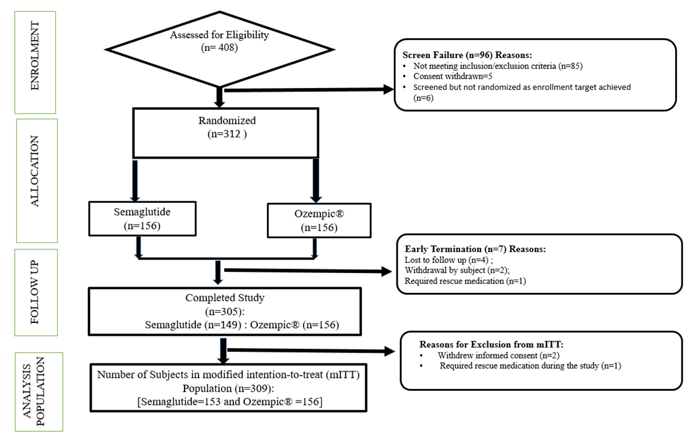
Study population characteristics Between January 2025, and August 2025, a total of 408 patients were screened at 17 centers across India, of which 96 patients were screen failures and then 312 patients were randomized (Figure 1). All 312 (100%) randomized subjects were included in safety set, 309 (99.0 %) in mITT and 286 (91.7 %) were part of PP population. Figure 1. CONSORT diagram displaying the flow of participants through the study. In the SS population, 173 (55.4%) were male and 139 (44.6%) were female. The median age of enrolled patients was 50.0 years (ranging from 28 to 64 years). The mean (SD) baseline body weight was 75.95 (14.28) kg.
Demographic and baseline characteristics were comparable between the two treatment groups (Table 1). The mean (SD) treatment compliance at week 24 was 98.26 % (10.34) [96.79 % for Semaglutide and 99.73 % for Ozempic® ]. Table 1. Summary of demography and baseline characteristics: Demographic Variable Statistic Semaglutide (N=156) Ozempic® (N=156) Overall (N=312) Age (Year) Mean (SD) 49.59 (8.24) 48.32 (9.49) 48.96 (8.90) Median (min-max) 51.00 (30.00:63.00) 49.00 (28.00:64.00) 50.00 (28.00:64.00) Gender Female 71(45.5%) 68(43.6%) 139(44.6%) Male 85(54.5%) 88(56.4%) 173(55.4%) Weight (Kg) Mean (SD) 75.98 (14.64) 75.92 (13.96) 75.95 (14.28) Race Asian 156(100.0%) 156(100.0%) 312(100.0%) Baseline Characteristics Statistic Semaglutide (N=153) Ozempic® (N=156) Overall (N=309) HbA1c Mean (SD) 8.70 (0.96) 8.69 (0.97) 8.69 (0.96) FPG Mean (SD) 137.23 (44.72) 135.71 (50.46) 136.46 (47.63) PPG Mean (SD) 228.53 (101.47) 223.31 (89.98) 225.90 (95.72) Abbreviations: SD, Standard deviation; kg, kilogram; m, meter; min-max, minimum-maximum; HbA1c, glycated hemoglobin; FPG, fasting plasma glucose; PPG, post-prandial glucose.
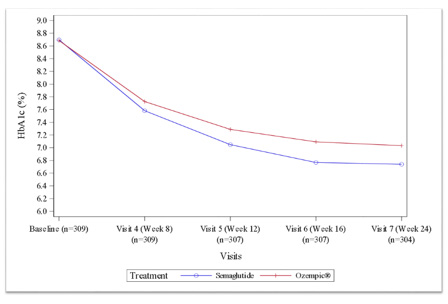
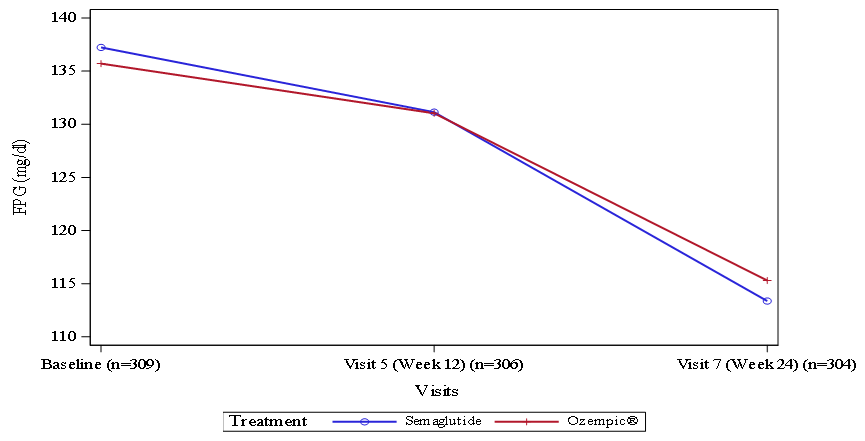
Efficacy results In the mITT population [N=304 (Semaglutide=148 and Ozempic® =156), at week 24, the mean (SE) reduction in HbA1c from baseline in the Semaglutide group was -1.95 (0.09), which was comparable to Ozempic® group -1.65 (0.09). The difference amounted to -0.30 (95% CI: -0.54:-0.05), demonstrating non-inferiority of Semaglutide injection (Generic) to Ozempic® , (Figure 2). The mean reduction in HbA1c from baseline to week 24 was also comparable in the PP population, Figure 2. Line graph of summary of actual values at baseline, week 8, week 12, week 16 and week 24 in HbA1c parameter - mITT population (N=309). For mean change in FPG from baseline to week 12, the least mean (SE) for the Semaglutide arm was -5.40 (3.68) and for the Ozempic® arm -5.50 (3.63).
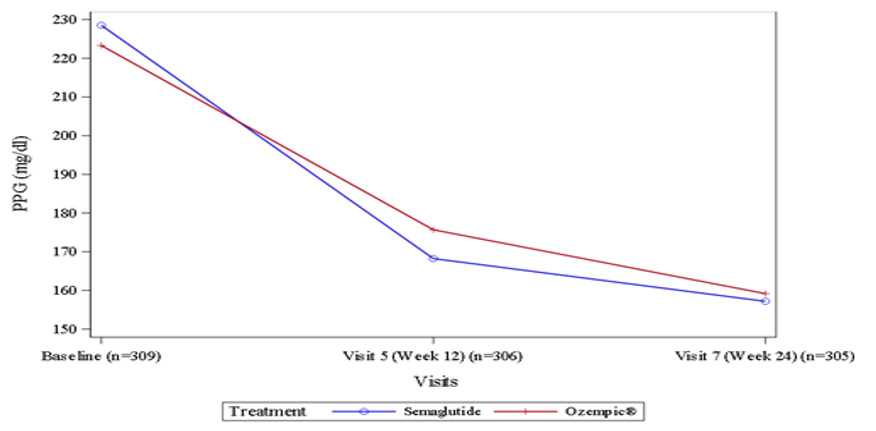
The difference (95 % CI) was 0.09 (-10.07:10.26). At week 24, the difference (95 % CI) was -1.95 (-9.77:5.86) (Figure 3a). For mean change in PPG from baseline to week 12, both treatments achieved substantial reductions in 2-hr PPG, with decreases of –59.83 mg/dL for Semaglutide and –47.64 mg/dL for Ozempic® . The continued reductions were observed through Week 24 (–70.28 mg/dL with Semaglutide and –64.15 mg/dL with Ozempic® (Figure 3b). Figure 3a. Change in mean fasting plasma glucose at week 12 & week 24 Figure 3b. Change in mean post prandial glucose at week 12 & week 24. There was comparable reduction in weight from baseline to week 12 and week 24 in both arms.
Patients with higher body mass index (BMI) (>27 kg/m2) showed larger decrease in weight as compared to patients with lower BMI (18-27 kg/m2). For patients with BMI > 27 kg/m2, the treatment difference (95% CI) in weight for from baseline to week 12 and 24 were 0.10 (-0.63- 0.83) and 0.05 (-1.26:1.36), respectively (Table 2). ). At week 12 and week 24, therapeutic glycemia response rate (HbA1c <7 %) in the Semaglutide arm was numerically higher than Ozempic® and the 95% CI of the difference between the percentages of response rates was (-0.04:0.19) and (-0.09:0.14), respectively. Table 2. Mean change in body weight from baseline to week 12 and week 24 BMI Week Treatment Group Change in Body Weight from base line[(Mean(SD)] Difference (95% CI)1 BMI 18-27 kg/m2 Week 12 Semaglutide (N=62) -2.44(0.28) -0.57(-1.34 : 0.19) Ozempic® (N=65) -1.87(0.27) Week 24 Semaglutide (N=61) -4.35(0.42) -0.98(-2.14 : 0.18) Ozempic® (N=65) -3.37(0.41) BMI > 27 kg/m2 Week 12 Semaglutide (N=88) -3.72(0.26) 0.10 (-0.63:0.83) Ozempic® (N=91) -3.82(0.26) Week 24 Semaglutide (N=87) -7.23(0.47) 0.05 (-1.26:1.36) Ozempic® (N=91) -7.28(0.46) The difference in mean weight and the corresponding 95% CI for the treatment difference.Abbreviations: BMI, Body mass index.
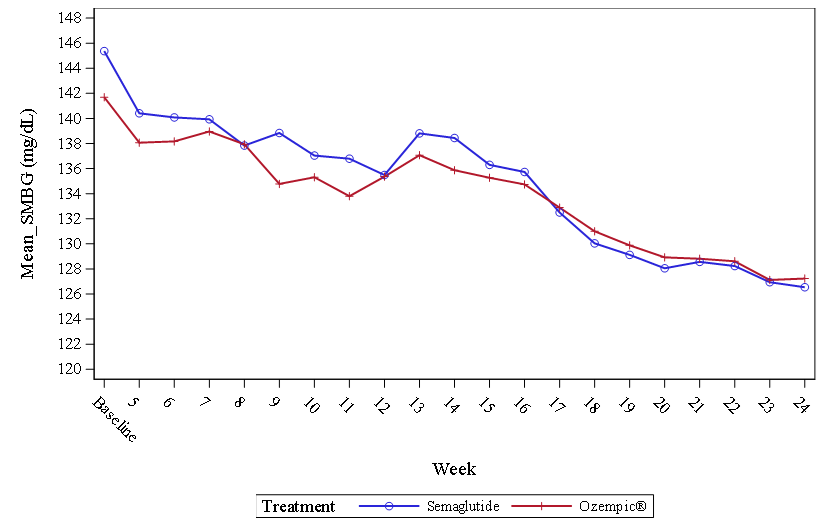
Throughout the study period of 24 weeks, SMBG was performed randomly by the patients. The mean of first 4 weeks of SMBG was considered as baseline. Subsequently, mean of every week was analysed. As shown in figure, there had been consistent decrease in the random SMBG value throughout the study period. (Figure 4). Figure 4. Line graph of summary of actual values at baseline (week 0 to 4), to week 24 in SMBG parameter-mITT population (N=309) Safety results Of the 312 patients in SS population, TEAEs by system organ class (SOC) and preferred term (PT) observed in at least 2% of patients were abdominal distention 5.4% (Semaglutide 4.5% vs Ozempic® 6.4%), diarrhoea 8.0% (Semaglutide 9.0% vs Ozempic® 7.1%), nausea 8.7% (Semaglutide 9% vs Ozempic® 8.3%), vomiting 4.5% (Semaglutide 5.8% vs Ozempic® 3.2 %), and headache 2.6% (Semaglutide 2.6% vs Ozempic® 2.6%).
The TEAEs occurred in at least 2% of patients were comparable in the Semaglutide and Ozempic® groups (Table 3). The majority (98.0%) of TEAEs were considered mild in severity. No potential life-threatening TEAEs or death was reported in the study in any arm throughout the study. No symptomatic hypoglycaemic episodes were reported in any of the patients in the study during the study conduct. These events were less and comparable in both the treatment groups. Overall, the events of laboratory related low plasma glucose (FPG < 70 mg/dl) were observed in 48 (15.4%) patients [(Semaglutide 21 (13.5%) vs 27 (17.3%)]. A quantitative anti-drug antibody (ADA) test performed in 64 subjects (32 in each arm) and none of the subjects in either arm revealed any ADA for Semaglutide.
Based on the ADA profile, the neutralizing antibody (Nab) test was not performed. A validated method was used to determine the ADA/Nab. Table 3. TEAEs by system organ class (SOC) and preferred term (PT) in ≥2% of patients –safety set population. Semaglutide (N=156) Ozempic® (N=156) Overall (N=312) TEAEs (≥2% of patients) by SOC and PT n (%) n (%) n (%) Gastrointestinal Disorders Abdominal distension 7(4.5%) 10(6.4%) 17(5.4%) Abdominal pain upper 3(1.9%) 4(2.6%) 7(2.2%) Diarrhoea 14(9.0%) 11(7.1%) 25(8.0%) Hyperchlorhydria 3(1.9%) 4(2.6%) 7(2.2%) Nausea 14(9.0%) 13(8.3%) 27(8.7%) Vomiting 9(5.8%) 5(3.2%) 14(4.5%) Nervous System Disorders Headache 4(2.6%) 4(2.6%) 8(2.6%) Treatment Emergent Adverse Events represented as: Patient count (Percentage of patients) A patient might have reported more than one adverse event.
Abbreviations
TEAEs, Treatment emergent adverse events
Discussion
The current randomized controlled study conducted in India involving 312 patients clearly established that Semaglutide injection (Generic) was non-inferior to Ozempic® with respect to the change in HbA1c parameter after continuous once weekly treatment over a period of 24 weeks. PP analyses of the change in HbA1c parameter following the 24-week treatment were complemented by the non-inferiority of Semaglutide to Ozempic® observed in mITT population. The magnitude of mean HbA1c reduction is consistent with that previously reported in the SUSTAIN clinical trial programme [12-21]. Additionally, continued trend of clinically meaningful reductions in FPG and PPG were observed through week 12 and week 24. Furthermore, there was a comparable decrease in random SMBG values in both treatment arms.
The greater glycaemic efficacy of semaglutide suggests that simple dose escalation would be possible for patients unable to reach treatment targets. The incidence of hypoglycemia was comparable with innovator data. At Week 24, changes in body weight from baseline were observed in the majority of participants with comparable patterns across groups. Patients with higher body mass index (BMI) (>27 kg/m2) showed larger decrease in weight as compared to patients with lower BMI (18-27 kg/m2), reinforcing the compound’s effective glycemic regulation and overall metabolic control in individuals with type 2 diabetes mellitus. To our knowledge, this is the first randomized, active-controlled study report unequivocally demonstrating the non-inferior efficacy and safety of Semaglutide injection (Generic) as compared to Ozempic® in patients with T2DM from India.
While the authors acknowledge possible limitations, including but not limited to the potential for not meeting non-inferiority at some secondary endpoints, which could be attributed to the a-priori sample size calculation being based only on the primary efficacy endpoint, the findings are nonetheless justifiably robust. The TEAE profile of Semaglutide was comparable to that of Ozempic® . In particular, consistent with the GLP-1 receptor agonist drug class, the most prevalent adverse events were gastrointestinal in nature in both treatment groups. Additionally, treatment with Semaglutide did not elicit an immune response, supporting its favourable immunogenicity profile over the 24-week study period. The hypoglycaemic episodes, and the corresponding event rates, were low and comparable in both the treatment groups.
Overall, Semaglutide was found to be generally safe and well tolerated over 24 weeks of treatment. There were no SAEs or deaths reported in the study. In conclusion, the present study confirms that generic semaglutide provides glycemic control non-inferior to comparator (Ozempic® ) under conditions reflective of clinical practice. Acknowledgement Authors thank all the participants, Investigators, site staff and Ethics Committees involved for their co-operation in smooth conduct of the study. The authors acknowledge the service provided by JSS Medical Research Asia Pacific Pvt. Limited-A Contract Research Organization. The study was conducted on behalf of Dr. Reddy’s Laboratories Limited by JSS Medical Research Asia Pacific Pvt. Ltd. Tower 2, 1st Floor, South Wing, L&T Business Park, plot no 12/4, Sector 27 D, Delhi Mathura Road, Faridabad, Haryana, India-121003.
JSS was responsible for providing the following services: study management, monitoring, safety reporting, medical monitoring, vendor management, data management, statistics and quality assurance. Conflict Of Interest/Disclosure Statement The authors PA, AKS, JMS and SKC having affiliation to 18 are full time employees of Dr. Reddy’s Laboratories Ltd. The authors having affiliation to 1-17 are the investigators who recruited the patients and reviewed this manuscript and they declared that no competing interests exist. Sources Of Funding The study was sponsored (completely funded) by Dr. Reddy’s Laboratories Limited, a for-profit organization involved in development, registration, licensing and commercialization of drug products. Data Availability Statement The data that support the findings of this study are available from the corresponding author, upon reasonable request.
Clinical Trial Registry Number CTRI/2024/10/074715 Author Contributions PA conceived and designed the study. SKC analysed the data. PA, AKS, JMS, SKC, interpreted the data. JMS prepared draft of the article. PA, AKS, JMS, SKC critically reviewed the manuscript. The authors having affiliation to 1-17 are the investigators who recruited the patients and reviewed this manuscript. PA & AKS approved the article to be communicated for publication. Ethical Consideration Institutional ethics committee of each centre approved the study. Written informed consent was obtained from each patient prior to screening on the approved informed consent form (ICF). The study was conducted in compliance with the ethical principles that originate in the Declaration of Helsinki and the International Conference on Harmonization (ICH) guidelines for good clinical practice (GCP) and applicable regulatory requirements.
Figures and Tables
| Demographic Variable | Statistic | Semaglutide (N=156) | Ozempic® (N=156) | Overall (N=312) |
|---|---|---|---|---|
| Age (Year) | Mean (SD) | 49.59 (8.24) | 48.32 (9.49) | 48.96 (8.90) |
| Median (min-max) | 51.00 (30.00:63.00) | 49.00 (28.00:64.00) | 50.00 (28.00:64.00) | |
| Gender | Female | 71(45.5%) | 68(43.6%) | 139(44.6%) |
| Male | 85(54.5%) | 88(56.4%) | 173(55.4%) | |
| Weight (Kg) | Mean (SD) | 75.98 (14.64) | 75.92 (13.96) | 75.95 (14.28) |
| Race | Asian | 156(100.0%) | 156(100.0%) | 312(100.0%) |
| Baseline Characteristics | Statistic | Semaglutide (N=153) | Ozempic® (N=156) | Overall (N=309) |
| HbA1c | Mean (SD) | 8.70 (0.96) | 8.69 (0.97) | 8.69 (0.96) |
| FPG | Mean (SD) | 137.23 (44.72) | 135.71 (50.46) | 136.46 (47.63) |
| PPG | Mean (SD) | 228.53 (101.47) | 223.31 (89.98) | 225.90 (95.72) |
| BMI | Week | Treatment Group | Change in Body Weight from base line[(Mean(SD)] | Difference (95% CI)1 |
|---|---|---|---|---|
| BMI 18-27 kg/m2 | Week 12 | Semaglutide (N=62) | -2.44(0.28) | -0.57(-1.34 : 0.19) |
| Ozempic® (N=65) | -1.87(0.27) | |||
| Week 24 | Semaglutide (N=61) | -4.35(0.42) | -0.98(-2.14 : 0.18) | |
| Ozempic® (N=65) | -3.37(0.41) | |||
| BMI > 27 kg/m2 | Week 12 | Semaglutide (N=88) | -3.72(0.26) | 0.10 (-0.63:0.83) |
| Ozempic® (N=91) | -3.82(0.26) | |||
| Week 24 | Semaglutide (N=87) | -7.23(0.47) | 0.05 (-1.26:1.36) | |
| Ozempic® (N=91) | -7.28(0.46) |
| Semaglutide (N=156) | Ozempic® (N=156) | Overall (N=312) | |
|---|---|---|---|
| TEAEs (≥2% of patients) by SOC and PT Gastrointestinal Disorders | n (%) | n (%) | n (%) |
| Abdominal distension | 7(4.5%) | 10(6.4%) | 17(5.4%) |
| Abdominal pain upper | 3(1.9%) | 4(2.6%) | 7(2.2%) |
| Diarrhoea | 14(9.0%) | 11(7.1%) | 25(8.0%) |
| Hyperchlorhydria | 3(1.9%) | 4(2.6%) | 7(2.2%) |
| Nausea | 14(9.0%) | 13(8.3%) | 27(8.7%) |
| Vomiting Nervous System Disorders | 9(5.8%) | 5(3.2%) | 14(4.5%) |
| Headache | 4(2.6%) | 4(2.6%) | 8(2.6%) |
References
- Davies MJ, Aroda VR, Collins BS, et al. Management of Hyperglycemia in Type 2 Diabetes, 2022. A Consensus Report by the American Diabetes Association (ADA) and the European Association for the Study of Diabetes (EASD). Diabetes Care. 2022;45:2753-2786.
- Pradeepa R, Mohan V. Epidemiology of type 2 diabetes in India. Indian J Oph-thalmol. 2021;69:2932-2938
- American Diabetes Association 6. Glycemic Targets: Standards of Medical Care in Diabetes 2020. Diabetes Care 2020;43: S66–76. 10.2337/dc20-S006
- Feingold KR. Oral and Injectable (Non-Insulin) Pharmacological Agents for the Treatment of Type 2 Diabetes. [Updated 2024 Sep 11]. In: Feingold KR, Ahmed SF, Anawalt B, et al., editors. Endotext [Internet]. South Dartmouth (MA): MDText.com, Inc.; 2000-. Available from: https://www.ncbi.nlm.nih.gov/books/NBK279141/
- El Sayed NA, Aleppo G, Aroda VR, et al. Pharmacologic Approaches to Glycemic Treatment: Standards of Care in Diabetes – 2023. Diabetes Care, 2023.
- Ruissen MM, Rodriquez-Gutierrez R, Montori VM, et al. Making Diabetes Care Fit – Are We Making Progress? Front Clin Diabetes Healthc, 2021
- Potts JE, Gray LJ, Brady EM, et al. The effect of glucagon-like peptide 1 receptor agonists on weight loss in type 2 diabetes: a systematic review and mixed treatment comparison meta-analysis. PLoS One. 2015; 10: e0126769.
- Van Can J, Sloth B, Jensen CB, et al. Effects of the once-daily GLP-1 analog lirag-lutide on gastric emptying, glycemic parameters, appetite and energy metabolism in obese, non-diabetic adults. Int J Obes (Lond) 2014; 38: 784–93.
- Farr OM, Sofopoulos M, Tsoukas MA, et al. GLP-1 receptors exist in the parietal cortex, hypothalamus and medulla of human brains, and the GLP-1 analogue lirag-lutide alters brain activity related to highly desirable food cues in individuals with di-abetes: a crossover, randomised, placebo-controlled trial. Diabetologia 2016; 59: 954–65
- Secher A, Jelsing J, Baquero AF, et al. The arcuate nucleus mediates GLP-1 recep-tor agonist liraglutide-dependent weight loss. J Clin Invest 2014; 124: 4473–88.
- Sorli C, Harashima S-I, Tsoukas GM, et al. Efficacy and safety of once-weekly semaglutide monotherapy versus placebo in patients with type 2 diabetes (SUSTAIN 1): a double-blind, randomised, placebo-controlled, parallel-group, multinational, mul-ticentre phase 3a trial. Lancet Diabetes Endocrinol 2017; 5:251–60.
- Frías JP, Auerbach P, Bajaj HS, et al. Efficacy and safety of once-weekly semag-lutide 2·0 mg versus 1·0 mg in patients with type 2 diabetes (SUSTAIN FORTE): a double-blind, randomised, phase 3B trial. Lancet Diabetes Endocrinol. 2021; 9:563-574.
- Ahrén B, Masmiquel L, Kumar H, et al. Efficacy and safety of once-weekly semaglutide versus once-daily sitagliptin as an add-on to metformin, thiazolidinedi-ones, or both, in patients with type 2 diabetes (SUSTAIN 2): a 56-week, double-blind, phase 3a, randomised trial. Lancet Diabetes Endocrinol 2017; 5: 341–54.
- Ahmann AJ, Capehorn M, Charpentier G, et al. Efficacy and safety of once-weekly semaglutide versus exenatide ER in subjects with type 2 diabetes (SUSTAIN 3): a 56-week, open-label, randomized clinical trial. Diabetes Care 2018; 41: 258–66.
- Aroda VR, Bain SC, Cariou B, et al. Efficacy and safety of once weekly semag-lutide versus once-daily insulin glargine as add-on to metformin (with or without sul-fonylureas) in insulin-naive patients with type 2 diabetes (SUSTAIN 4): a randomised, open-label, parallel-group, multicentre, multinational, phase 3a trial. Lancet Diabetes Endocrinol 2017; 5:355–66.
- Rodbard HW, Lingvay I, Reed J, et al. Semaglutide added to basal insulin in type 2 diabetes (SUSTAIN 5): a randomized, controlled trial. J Clin Endocrinol Metab 2018; 103: 2291–301.
- Marso SP, Bain SC, Consoli A, et al. Semaglutide and cardiovascular outcomes in patients with type 2 dia-betes. N Engl J Med 2016; 375: 1834–44.
- Pratley RE, Aroda VR, Lingvay I, et al. Semaglutide versus dulaglutide once weekly in patients with type 2 diabetes (SUSTAIN 7): a randomised, open-label, phase 3b trial. Lancet Diabetes Endocrinol 2018; 6: 275–86.
- Lingvay I, Catarig AM, Frias JP, et al. Efficacy and safety of once weekly semag-lutide versus daily canagliflozin as add-on to metformin in patients with type 2 diabe-tes (SUSTAIN 8): a Double blind, phase 3b, randomised controlled trial. Lancet Dia-betes Endocrinol 2019; 7: 834– 44.
- Zinman B, Bhosekar V, Busch R, et al. Semaglutide once weekly as add-on to SGLT-2 inhibitor therapy in type 2 diabetes (SUSTAIN 9): a randomised, placebo-controlled trial. Lancet Diabetes Endocrinol 2019; 7: 356–67.
- Capehorn MS, Catarig AM, Furberg JK, et al. Efficacy and safety of once-weekly semaglutide 1.0mg vs once-daily liraglutide 1.2 mg as add-on to 1-3 oral antidiabetic drugs in subjects with type 2 diabetes (SUS-TAIN 10). Diabetes Metab 2020; 46: 100
This is a text version generated from the article. For the formatted version of record (with original tables & figures), download the PDF →