Full Text Hide / show
Background
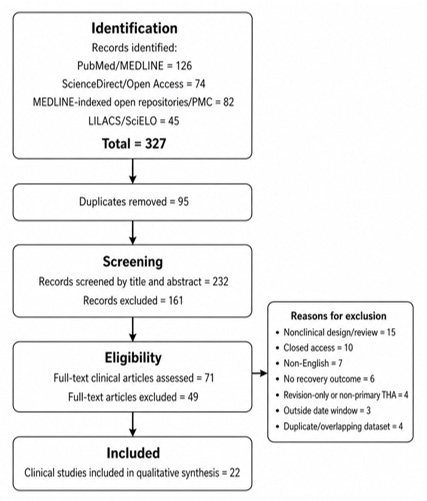
The direct anterior approach (DAA) for total hip arthroplasty (THA) has been proposed as a muscle-sparing surgical route that may accelerate postoperative recovery. Nevertheless, the magnitude, consistency, and durability of this advantage remain debated. Objective: To synthesize open-access, English-language clinical studies evaluating DAA in THA and its relationship with postoperative recovery. Methodology: PubMed/MEDLINE, ScienceDirect/Open Access, MEDLINE-indexed open repositories, and LILACS/SciELO were searched. Eligible studies were randomized clinical trials, prospective comparative studies, retrospective comparative cohorts, propensity-score matched cohorts, and clinical cohort studies with patient-level postoperative outcomes. Reviews, meta-analyses, editorials, technique-only articles, non- English studies, closed-access articles, case reports, and revision-only THA studies were excluded. A total of 327 records were identified; 232 records were screened after duplicate removal; 71 full-text clinical articles were assessed for eligibility; and 22 clinical studies were included in the qualitative synthesis.
Quality assessment: Randomized trials were appraised using domains consistent with the Cochrane RoB 2 framework. Nonrandomized clinical studies were assessed using principles consistent with ROBINS-I, emphasizing confounding, selection bias, outcome measurement, missing data, and selective reporting. Results: The clinical evidence included suggests that DAA may improve early postoperative recovery, particularly early pain, early mobilization, physical activity, gait-aid discontinuation, length of stay, and short-term patient-reported function. However, functional differences commonly diminish by 3 to 12 months. Complications and recovery outcomes are strongly influenced by surgeon experience, patient selection, wound risk, femoral exposure, perioperative protocols, and rehabilitation pathways. Conclusion: DAA may accelerate early postoperative recovery after THA in selected patients and experienced centers.
However, current clinical evidence does not demonstrate consistent medium- or long-term functional superiority over other well-performed approaches. The overall certainty of evidence is moderate for early recovery and low-to-moderate for sustained functional superiority. Keywords: total hip arthroplasty; direct anterior approach; postoperative recovery; clinical studies; rehabilitation; length of stay.
Introduction
Total hip arthroplasty is one of the most successful procedures in adult reconstructive orthopedic surgery, providing substantial pain relief, improved mobility, and restoration of quality of life in patients with advanced hip disease. Traditionally, the success of THA was evaluated primarily through implant survivorship, complication rates, and radiographic stability. In contemporary practice, however, postoperative recovery has become an equally relevant endpoint, particularly because patients and health systems increasingly value early ambulation, reduced hospitalization, rapidfunctionalindependence,andreturntodailyactivities[1]. The surgical approach used for THA may influence the early recovery pathway by affecting soft-tissue trauma, postoperative pain, muscle function, gait mechanics, and rehabilitation tolerance. Conventional posterior, posterolateral, lateral, and transgluteal approaches have long demonstrated reliable implant positioning and durable clinical results.
Nevertheless, these approaches may involve splitting, detachment, or manipulation of periarticular muscles and capsule, which can influence early pain, gait, and activity limitation during the immediate postoperative phase [2]. The direct anterior approach has gained attention because it follows an intermuscular and internervous plane, theoretically reducing muscle damage during hip exposure. This anatomical rationale has been supported by clinical observations showing reduced markers of muscle injury and inflammation in patients treated through anterior minimally invasive approaches compared with posterior approaches. These findings provide a biological basis for the hypothesis that DAA may facilitate early mobilization and functional recovery after THA [3]. Clinical recovery after THA is multidimensional and cannot be reduced to a single score.
Relevant outcomes include pain intensity, opioid requirement, physical therapy tolerance, gaitaid discontinuation, walking distance, stair climbing, length of hospital stay, patient-reported function, return to recreational activity, and complication profile. Because each of these outcomes may respond differently to surgical technique, rehabilitation protocols, and patient characteristics, the evaluation of DAA requires careful interpretation of clinical studies rather than reliance on anatomical theory alone [4]. Randomized and comparative clinical studies have reported that DAA may improve selected early recovery outcomes, including physical activity, functional testing, pain during rehabilitation, and early discharge readiness. However, the magnitude of these benefits varies between studies, and several investigations show convergence of patient-reported outcomes and functional scores after the early postoperative period.
This suggests that DAA may accelerate the initial recovery trajectory without necessarily changing the final functional endpoint for most patients [5]. The technical demands of DAA also require consideration. Although the approach may preserve muscular planes, it can be associated with wound-related problems, lateral femoral cutaneous nerve symptoms, femoral exposure difficulty, longer operative time during the learning curve, and approach-specific complications. Therefore, the clinical value of DAA depends not only on the approach itself, but also on patient selection, surgeon experience, perioperative care, and structured rehabilitation [6]. Given the growing clinical interest in surgical strategies that may optimize recovery after THA, a critical synthesis of patient-level clinical evidence is necessary to clarify the real contribution of DAA to postoperative outcomes.
Therefore, the objective of this study was to systematically review clinical studies evaluating the direct anterior approach in total hip arthroplasty and to determine whether this approach improves postoperative recovery when compared with other surgical approaches or DAA technique variants. METODOLOGY Design and research question This study was designed as a systematic review and was structured according to PRISMA principles, with the aim of ensuring transparency, reproducibility, and methodological rigor in the identification, selection, and synthesis of evidence. The review was restricted to clinical studies with patient-level data, because the central purpose was to evaluate postoperative recovery outcomes observed directly in patients undergoing total hip arthroplasty. Therefore, reviews, meta-analyses, technical descriptions, protocols, and nonclinical publications were not considered eligible for the main synthesis.
The research question was formulated using the PICO framework, which allowed the review question to be organized according to population, intervention, comparison, and outcomes. PICO framework Population (P): Adults undergoing primary total hip arthroplasty. Intervention (I): Total hip arthroplasty performed through the direct anterior approach. Comparison (C): Total hip arthroplasty performed through posterior, posterolateral, lateral, direct lateral, transgluteal, or other conventional surgical approaches. Studies comparing different technical variants of the direct anterior approach were also considered eligible when postoperative recovery outcomes were reported. Outcomes (O): Postoperative recovery outcomes, including pain, early mobilization, gait recovery, physical therapy tolerance, length of hospital stay, physical activity level, functional scores, patient-reported outcomes, return to daily or recreational activities, and postoperative complications.
Based on this framework, the guiding question of the review was: In adults undergoing primary total hip arthroplasty, does the direct anterior approach improve postoperative recovery outcomes when compared with other surgical approaches or direct anterior approach technique variants? Data sources and search terms A structured literature search was planned to identify openaccess clinical studies published in English and indexed in major biomedical and scientific databases. The databases consulted were PubMed/MEDLINE, ScienceDirect/Open Access, MEDLINE-indexed open repositories such as PubMed Central, and LILACS/SciELO. These sources were selected because they provide broad coverage of orthopedic, surgical, rehabilitation, and clinical research, while also allowing retrieval of full-text open-access publications. The search strategy combined terms related to the surgical procedure, the surgical approach, comparator approaches, and postoperative recovery outcomes.
The main descriptors and keywords included: “total hip arthroplasty”, “total hip replacement”, “direct anterior approach”, “anterior approach”, “posterior approach”, “posterolateral approach”, “direct lateral approach”, “transgluteal approach”, “postoperative recovery”, “functional recovery”, “rehabilitation”, “early mobilization”, “gait”, “pain”, “length of stay”, and “return to activity”. Boolean operators were used to increase the sensitivity and specificity of the search. A representative search strategy was: (“total hip arthroplasty” OR “total hip replacement”) AND (“direct anterior approach” OR “anterior approach”) AND (“postoperative recovery” OR “functional recovery” OR “rehabilitation” OR “length of stay” OR “pain” OR “gait”). The search terms were adapted when necessary, according to the indexing structure and search interface of each database. Eligibility criteria Eligibility criteria were defined before study selection in order to minimize selection bias and ensure consistency during screening.
Studies were included when they met all of the following criteria: they were published in English; available as open-access full text; published between January 2011 and May 2026; designed as clinical studies with patient-level data; evaluatedprimarytotalhiparthroplastyusingthedirectanterior approach as an intervention or comparator; and reported at least one postoperative recovery-related clinical outcome. The eligible clinical designs included randomized controlled trials, prospective comparative studies, retrospective comparative cohorts, propensity-score matched cohorts, and clinical cohort studies. Recovery-related outcomes were broadly defined to include early pain, functional recovery, gait, early mobilization, physical therapy tolerance, activity level, length of stay, return to daily or recreational activities, patient-reported outcomes, and complications. Studies were excluded when they did not provide original clinical data or did not directly address the review question.
Exclusion criteria comprised reviews and meta-analyses, protocols, technique-only descriptions, editorials, letters without clinical data, case reports, cadaveric studies, imagingonly studies, closed-access articles, non-English publications, revision-only total hip arthroplasty studies, and studies that did not report postoperative recovery or clinical outcome data. Study selection The study selection process was performed in sequential stages. First, titles and abstracts were screened to identify records that were potentially relevant to the review question. Articles clearly unrelated to direct anterior approach total hip arthroplasty,postoperativerecovery,orclinicaloutcomeswere excluded at this stage. Duplicate records retrieved from more than one database were removed before full-text assessment. In the second stage, potentially eligible studies underwent full-text review. During this phase, each article was assessed against the predefined inclusion and exclusion criteria.
Particular attention was given to confirming whether the article was written in English, available as open-access full text, involved primary total hip arthroplasty, included patientlevel clinical data, and reported at least one postoperative recovery outcome. When multiple publications appeared to report overlapping patient populations or substantially duplicated clinical data, the study with the most complete and relevant postoperative recovery information was prioritized. This approach was adopted to avoid double-counting patients and to preserve the integrity of qualitative synthesis. Data extraction Dataextractionwasperformedusingastandardizedframework designed to capture methodological characteristics, clinical context, and recovery-related outcomes from each eligible study. For every included article, the extracted information comprised author and year of publication, study design, type of comparator, population or clinical setting, surgical approach evaluated, postoperative recovery outcomes, main findings, risk-of-bias concerns, and relevance to recovery after direct anterior approach total hip arthroplasty.
The extraction process emphasized outcomes directly related to the postoperative recovery trajectory. These included pain intensity, physical therapy tolerance, gait-aid discontinuation, early ambulation, walking ability, functional scores, patient-reported outcomes, hospital length of stay, return to recreational or daily activities, and postoperative complications. When available, additional information regarding follow-up duration, study setting, perioperative protocols, rehabilitation strategies, and methodological limitations was also recorded to support a more comprehensive interpretation of the evidence. The study selection process was summarized visually using a PRISMA flow diagram, presented as Figure 1. This figure illustrates the sequential phases of identification, duplicate removal, screening, eligibility assessment, exclusion of full-text articles with reasons, and final inclusion of studies in the qualitative synthesis.
The flow diagram was included to provide transparency regarding how the initial records were reduced to the final set of clinical studies analyzed in the review. Because the included studies varied in design, population characteristics, comparator approach, rehabilitation protocol, follow-up duration, and outcome measures, the extracted data were synthesized qualitatively rather than through pooled meta-analysis. This narrative synthesis allowed comparison of patterns across studies while acknowledging methodological and clinical heterogeneity. In addition, all retrieved references were imported, organized, and managed using Zotero before screening, eligibility assessment, and final data extraction. Figure 1. PRISMA Flow Diagram Illustrating the Identification, Screening, Eligibility, and Inclusion of Clinical Studies. Quality assessment The methodological quality of included studies was assessed according to study design.
Randomized controlled trials were appraised using domains consistent with the Cochrane Risk of Bias 2 framework. The domains considered included the randomization process, deviations from the intended intervention, missing outcome data, outcome measurement, and selective reporting. Because surgical trials cannot fully blind surgeons and often cannot blind patients, special attention was given to the possible influence of lack of blinding on subjective outcomes such as pain, satisfaction, and self-reported function. Nonrandomized clinical studies were assessed using principles consistent with ROBINS-I. The domains considered included confounding, selection of participants, classification of interventions, deviations from intended intervention, missing data, outcome measurement, and selection of reported results. Attention was given to confounding by surgeon experience, patient selection, body habitus, baseline functional status, perioperative protocols, institutional fast-track pathways, and learning-curve effects.
The final quality judgment for each study was summarized as low risk, some concerns, moderate risk, or serious risk, depending on the study design and the degree to which methodological limitations could affect interpretation of postoperative recovery outcomes. This assessment was used to support qualitative synthesis and to contextualize the strength of evidence across recovery domains.
Results
Twenty-two clinical studies met the inclusion criteria and were included in the qualitative synthesis. The evidence base comprised randomized clinical trials, prospective comparative studies, retrospective comparative cohorts, propensity-score matched cohorts, and clinical cohort studies reporting patientlevel postoperative recovery outcomes [1-22]. The included studies were organized according to study design, comparator approach, recovery-related outcomes, main findings, and methodological quality, as shown in the tables below. Most studies compared the direct anterior approach with posterior or posterolateral approaches, followed by direct lateral, standard lateral, and transgluteal approaches [1,4- 7,9-12,18,20]. Although the outcomes varied across studies, the most frequently assessed domains were pain, early mobilization, gait-related recovery, length of hospital stay, functional scores, return to activity, and complications [1-22].
Overall, the results suggest that DAA may provide advantages during the early postoperative period, particularly in relation to pain, mobility, activity level, and discharge readiness. However, several studies demonstrated that these differences tended to diminish during medium- and longer-term followup [6,7,10,12,19]. Table 1 presents the main characteristics and recoveryrelated findings of the included clinical studies. This table was designed to provide a structured overview of the evidence base, allowing comparison across study designs, surgical comparators, postoperative outcomes, and main interpretations. It shows that the clinical literature includes both randomized and nonrandomized studies, with heterogeneous comparators and recovery measures. The table also demonstrates that early recovery advantages were most frequently reported in studies assessing activity cycles, early pain, length of stay, gait-aid discontinuation, and early functional outcomes [3-6,9-11,15,20,21].
At the same time, studies with longer follow-up or broader functional assessment frequently reported convergence between DAA and comparator approaches [6,7,10,12,19]. Table 1. Characteristics and recovery-related findings of included clinical studies. No. Study Design Comparison Recovery outcomes Main interpretation 1 Alecci et al., 2011 [1] Prospective clinical comparative cohort DAA vs standard lateral Perioperative variables, blood loss, pain, early mobility [1] DAA was associated with less perioperative impairment and faster early mobilization; nonrandomized design limits causal inference [1]. 2 Bergin et al., 2011 [2] Prospective comparative biomarker study DAA vs posterior Inflammatory and muscle-damage markers, early pain [2] DAA showed lower muscle-damage markers, supporting a musclesparing biological rationale [2]. 3 Connolly and Kamath, 2016 [3] Retrospective comparative cohort DAAvscontemporary comparators Length of stay, discharge, complications, early outcome [3] Contemporary DAA outcomes were favorable, but selection and surgeonexperience bias were relevant [3].
4 Fransen et al., 2016 [4] Comparative cohort DAA vs posterolateral Length of stay, blood loss, cup inclination, pain, complications [4] DAA shortened length of stay and improved cup inclination, but operative time and blood loss were higher [4]. 5 Reichert et al., 2018 [5] Randomized controlled trial DAA vs transgluteal Activity cycles, pain, function, gait-related recovery [5] DAA patients showed higher early activity counts and faster early recovery [5]. 6 Taunton et al., 2018 [6] Randomized clinical trial DAA vs miniposterior Gait aids, functional tests, patientreported outcomes, complications [6] DAA produced small early benefits, but most differences disappeared after early follow-up [6]. 7 Brismar et al., 2018 [7] Randomized trial, 5-year follow-up DAA vs direct lateral Pain, hip function, quality of life, complications [7] Early pain/function gain occurred with DAA, but no sustained 1- or 5-year superiority was demonstrated [7].
8 Trivellin et al., 2020 [8] Retrospective cohort DAA clinical cohort Length of stay, early pain, complications [8] DAA was associated with short length of stay and low early pain, but absence of randomization limited inference [8]. 9 Cao et al., 2020 [9] Randomized study DAA vs posterolateral Hemoglobin course, function, early recovery [9] DAA favored early functional recovery, but blood-loss profile required attention [9]. 10 Moerenhout et al., 2020 [10] Multicenter randomized clinical trial DAA vs posterior Harris Hip Score, VAS pain, length of stay, surgical time, complications [10] No major long-term differences were found; early functional trend favored DAA [10]. 11 Nistor et al., 2020 [11] Randomized controlled trial Anterior vs lateral/ posterior protocols Pain during physical therapy, rehabilitation tolerance [11] Surgical approach influenced therapy-related pain, supporting the relevance of approach in early rehabilitation [11].
12 Yuasa et al., 2021 [12] Comparative clinical follow-up DAA vs posterior 5-year outcomes, function, implant position [12] Longer follow-up showed broadly comparable outcomes, emphasizing convergence over time [12]. 13 Li et al., 2022 [13] Randomized clinical study DAA technique variants Hip stability/function, early recovery [13] DAA combined with capsular/tendon strategy improved early stability and function within the study context [13]. 14 Mead and Bugbee, 2022 [14] Retrospective comparative cohort DAA vs posterior Return to recreational activity, patient-reported outcomes [14] DAA increased likelihood of returning to previous recreational activity, with similar objective scores [14]. 15 Bontea et al., 2023 [15] Observational clinical study Anterior vs lateral/ standard care Early mobilization, length-of-stay predictors [15] Anterior approach was associated with earlier mobilization and shorter length of stay in a fast-track context [15].
16 Wu et al., 2023 [16] Clinical observational study DAA vs posterolateral Wound/ perioperative recovery outcomes [16] DAA and posterolateral approaches differed in perioperative recovery and wound-related parameters [16]. 17 Wang et al., 2024 [17] Clinical comparative study DAA vs posterolateral Pain, imaging, length of stay, early outcome [17] DAA favored short-term pain and length of stay, but interpretation was limited by nonrandomized design [17]. 18 Hoseth et al., 2024 [18] Exploratory randomized trial analysis DAA vs direct lateral in fracture THA Inflammatory response, early recovery markers [18] DAA showed lower inflammatory response in THA for femoral neck fracture [18]. 19 Foster et al., 2025 [19] Clinical comparative cohort Anterior vs posterior Self-reported and functional outcomes at 3 months and 1 year [19] Outcomes were similar by 3 months and 1 year, despite possible early differences [19].
20 Hoseth et al., 2025 [20] Randomized controlled trial DAA vs direct lateral in fracture THA Timed Up and Go, Oxford Hip Score, Forgotten Joint Score, EQ-5D [20] DAA compared favorably in selected early functional parameters after fracture THA [20]. 21 Wang et al., 2025 [21] Propensity-score matched cohort DAA vs conventional approaches Early recovery outcomes, pain, function [21] Propensity matching supported improved early recovery with DAA while reducing measured confounding [21]. 22 Park et al., 2025 [22] Retrospective comparative cohort DAA vs posterolateral Clinical outcomes, radiographs, complications [22] DAA benefits were mainly early; approach selection remained dependent on surgeon and patient factors [22]. Legend: DAA = direct anterior approach; THA = total hip arthroplasty; VAS = visual analogue scale; EQ-5D = EuroQol-5 Dimension; patient-reported outcomes include hip-specific and general health-related function scores.
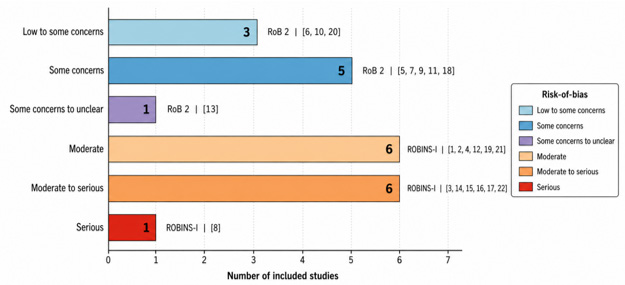
The numerical citations in each row identify the study supporting the corresponding data. Figure 2 presents the methodological quality assessment of the 22 clinical studies included in the systematic review. The studies were grouped according to their risk-of-bias judgment, allowing visual comparison of the overall methodological robustness of the evidence base. Randomized studies were assessed using criteria consistent with Cochrane RoB 2, whereas nonrandomized studies were evaluated using principles consistent with ROBINS-I. The figure shows that most studies were classified as having moderate or moderate-to-serious risk of bias, with six studies in each category. Five studies were classified as having some concerns, three as low to some concerns, one as some concerns to unclear, and one as serious risk of bias.
This distribution indicates that, although the review included several randomized and comparative clinical studies, the overall evidence base was affected by relevant methodological limitations, especially among nonrandomized designs. Overall, Figure 2 supports a cautious interpretation of the findings. The presence of studies with moderate or higher risk of bias suggests that the observed advantages of the direct anterior approach in early postoperative recovery should be interpreted in the context of potential confounding, lack of blinding, differences in surgical experience, patient selection, and institutional rehabilitation protocols. Figure 2. Methodological Quality Assessment of the Included Clinical Studies. Table 3 summarizes the direction and certainty of evidence according to postoperative recovery domains. This table was included to synthesize the main clinical patterns observed across the included studies and to facilitate interpretation of the review findings by outcome category.
Rather than presenting each study individually, Table 3 groups the evidence into six clinically relevant domains: early pain, early mobilization and gait, length of stay, functional scores, return to activity, and complications. The strongest and most consistent signal favored DAA in the early postoperative phase. Early pain and rehabilitation-related pain were frequently lower among patients treated with DAA or anterior approaches [2,7,9,11,17]. Early mobilization and gaitrelated outcomes also tended to favor DAA, particularly in studies that evaluated activity cycles, gait-aid discontinuation, Timed Up and Go, or early physical mobility [5,6,15,20,21]. Length of stay was often shorter in DAA cohorts, although this outcome was judged as low to moderate certainty because it is highly dependent on discharge criteria, health-system organization, and fast-track institutional protocols [3,4,8,15,17].
Functional scores showed a more nuanced pattern. While early functional outcomes sometimes favored DAA, studies with medium- and longer-term follow-up frequently demonstrated convergence between DAA and comparator approaches [5- 10,12,19-21]. Return to activity was supported by more limited evidence, mainly from retrospective data showing a higher likelihood of resuming previous recreational activity after DAA [14]. Finally, the complication profile emphasized that DAA is not risk-free and may be associated with approach-specific concerns such as lateral femoral cutaneous nerve symptoms, wound issues, femoral exposure difficulty, and learning-curve-related complications [4,7,8,22]. Table 3. Summary of evidence by postoperative recovery domain. Outcome domain Direction of evidence Certainty Interpretive note Early pain DAA often showed lower early pain or less pain during physical therapy [2,7,9,11,17].
Moderate Effects were influenced by analgesia, rehabilitation intensity, and lack of blinding [2,7,9,11,17]. Early mobilization and gait DAA favored higher activity cycles, earlier gait-aid cessation, or faster mobility in several trials and cohorts [5,6,15,20,21]. Moderate Strongest effects occurred in the first days to 6 weeks [5,6,15,20,21]. Length of stay Several cohorts and comparative studies reported shorter length of stay with DAA [3,4,8,15,17]. Low to moderate Highly dependent on institutional fast-track pathways and discharge criteria [3,4,8,15,17]. Functional scores Early functional scores sometimes favored DAA [5- 10,20,21]. Moderate Differences commonly converged by 3 to 12 months [6,7,10,12,19]. Return to activity DAA was associated with higher likelihood of resuming previous recreational activity in one cohort [14].
Low to moderate Outcome was vulnerable to expectation, recall, and selection bias [14]. Complications DAA had approach-specific concerns, including lateral femoral cutaneous nerve symptoms, wound issues, femoral exposure difficulty, and learning-curve complications [4,7,8,22]. Moderate Safety depended strongly on surgeon experience and patient selection [4,7,8,22]. Legend: DAA = direct anterior approach.
Discussion
The present systematic review, restricted to clinical studies with patient-level data, indicates that the direct anterior approach may provide measurable advantages during the early postoperative recovery period after total hip arthroplasty. Across the included evidence, the most consistent benefits were observed in domains such as early pain, early mobilization, physical activity, gait-related milestones, functional independence, and length of hospital stay [1-6,9-11,15,17,20,21]. However, these benefits were not uniformly sustained over time. Several comparative and randomized studies suggested that functional differences between DAA and other approaches tend to decrease after the early postoperative phase, particularly between 3 and 12 months, and may no longer be clinically relevant during longer follow-up [6,7,10,12,19].
Therefore, the main contribution of DAA appears to be acceleration of the early recovery trajectory rather than consistent improvement of final functional outcomes. The biological plausibility of early recovery benefits is supported by the anatomical characteristics of DAA. Because this approach follows an intermuscular and internervous interval, it may reduce direct injury to periarticular muscles, particularly the abductor mechanism. This rationale is consistent with clinical studies reporting reduced muscledamage or inflammatory markers and improved early activity after anterior or minimally invasive anterior approaches [2,5,18]. Alecci et al. reported favorable perioperative findings when DAA was compared with a standard lateral approach, whereas Bergin et al. demonstrated lower markers of muscle damage and inflammation after anterior minimally invasive THA compared with posterior THA [1,2].
These findings help explain why DAA may be associated with earlier mobilization and improved early rehabilitation tolerance. Nevertheless, biological plausibility alone is insufficient to establish superiority, since studies with randomized or longer-term designs show that the early advantage may not persist beyond the initial recovery window [6,7,10,12,19]. Pain and rehabilitation tolerance represent central dimensions of postoperative recovery. Several studies suggest that DAA may reduce early postoperative pain or pain during physiotherapy, thereby facilitating standing, transfer training, ambulation, and participation in early rehabilitation [2,7,9,11,17]. Cao et al. reported differences in early recovery and hemoglobin trajectory between DAA and posterolateral approaches, while Nistor et al. specifically showed that surgical approach may influence pain levels during physical therapy [9,11].
Wang et al. also reported favorable shortterm clinical outcomes for DAA compared with posterolateral THA [17]. However, pain after THA is strongly influenced by multimodal analgesia, anesthesia, local infiltration, patient expectations, and rehabilitation protocols. Consequently, the effect of DAA on pain should be interpreted as part of a broader enhanced-recovery model rather than as an isolated consequence of the surgical approach alone [10,15]. Functional recovery and gait-related outcomes also favored DAA in several early assessments. Reichert et al. reported higher early activity cycles after DAA compared with a transgluteal approach, while Taunton et al. found small early advantages for DAA compared with a mini-posterior approach in gait-aid use and functional testing [5,6].
Similar early recovery signals were reported by Cao et al., Bontea et al., Hoseth et al., and Wang et al., particularly in relation to early function, mobilization, Timed Up and Go performance, and recovery-oriented outcomes [9,15,20,21]. These findings are clinically relevant because faster functional independence may reduce caregiver burden, support earlier discharge, and improve patient confidence during the immediate postoperative period. However, the durability of this benefit remains limited. Brismar et al., Moerenhout et al., Yuasa et al., and Foster et al. reported that early differences may diminish with time, with comparable medium- or longer-term outcomes between DAA and other approaches [7,10,12,19]. Thus, DAA may be better understood as an approach that shifts the early recovery curve forward rather than one that consistently changes the long-term endpoint.
Length of hospital stay was another outcome frequently associated with DAA, although this finding should be interpreted cautiously. Several clinical studies reported shorter hospitalization, earlier discharge, or favorable discharge-related outcomes after DAA [3,4,8,15,17]. Connolly and Kamath described favorable contemporary DAA outcomes, Fransen et al. reported shorter length of stay when DAA was compared with the posterolateral approach, and Trivellin et al. reported short hospitalization in a DAA clinical cohort [3,4,8]. Bontea et al. further emphasized the relationship between anterior approach, early mobilization, and length-of-stay predictors within a fast-track context [15]. Nevertheless, length of stay is highly dependent on institutional discharge criteria, health-system organization, social support, rehabilitation availability, and perioperative pathways.
Therefore, while DAA may contribute to shorter hospitalization, this outcome cannot be attributed exclusively to the surgical approach when enhanced-recovery protocols are simultaneously implemented [10,15]. Return to activity is an increasingly important patient-centered outcome after THA. Mead and Bugbee reported that patients treated through DAA had a higher likelihood of returning to previous recreational activities compared with those treated through a posterior approach, although objective outcome differences may be less pronounced [14]. This suggests that DAA may influence perceived readiness, confidence, and willingness to resume activity after surgery. However, return to sport or recreational activity is affected by several factors beyond approach, including preoperative activity level, age, comorbidities, implant fixation, surgeon recommendations, fear of movement, and rehabilitation progression [14,19].
Therefore, although DAA may support earlier confidence in selected patients, counseling should remain individualized and should avoid implying that DAA alone guarantees superior return-to-activity outcomes. The role of complications and the learning curve is essential when interpreting the clinical value of DAA. Although the approach may preserve muscular planes, it is not free of technical demands or approach-specific risks. Studies included in this review reported concerns related to wound complications, lateral femoral cutaneous nerve symptoms, femoral exposure difficulty, operative time, blood loss, and learning-curve-related complications [4,7,8,16,22]. Brismar et al. reported early pain and functional gains but also highlighted complication concerns during longer followup [7]. Wu et al. evaluated perioperative recovery and wound-related outcomes, while Park et al.
emphasized that approach-related benefits must be balanced against patient and surgeon factors [16,22]. These findings reinforce that DAA should not be interpreted as universally superior or technically benign. Rather, its safety and effectiveness depend on adequate training, careful patient selection, surgical volume, and familiarity with femoral exposure. The included studies also differed substantially in design, population, comparator, and indication. Some focused on elective primary THA for degenerative disease, whereas others evaluated THA for femoral neck fracture [18,20]. Hoseth et al. reported lower inflammatory response with DAA compared with direct lateral approach in fracture THA and later evaluated functional outcomes using measures such as Timed Up and Go, Oxford Hip Score, Forgotten Joint Score, and EQ-5D [18,20].
Although these studies are clinically valuable, fracture populations differ from elective osteoarthritis populations in baseline function, frailty, comorbidity burden, rehabilitation potential, and complication risk. Similarly, Li et al. evaluated DAA technique variants involving tendon release and repair, which provides useful information on technical refinements but may not be directly comparable with studies comparing DAA with posterior or lateral approaches [13]. This heterogeneity limits direct comparison across all studies and supports the decision to conduct a qualitative rather than pooled quantitative synthesis. The methodological quality assessment further supports a cautious interpretation of the findings. Randomized clinical trials provided stronger evidence but remained vulnerable to limitations inherent to surgical trials, particularly the impossibility of blinding surgeons and, often, patients [5-7,9- 11,18,20].
Nonrandomized studies contributed important real-world clinical information but were more susceptible to confounding by surgeon experience, patient selection, body habitus, institutional fast-track pathways, and learningcurve effects [1,3,4,8,12,14-17,19,21,22]. Propensity-score matching, as used by Wang et al., may reduce measured confounding, but it cannot eliminate unmeasured sources of bias [21]. Therefore, while the evidence supports early recovery advantages for DAA, the certainty of evidence is stronger for short-term recovery acceleration than for sustained superiority. From a clinical perspective, DAA may be considered a recoveryoriented approach for selected patients when performed by trained surgeons within structured perioperative pathways. Its strongest potential indication is not long-term superiority, but early recovery acceleration, including earlier walking, reduced early pain in some contexts, improved early confidence, and faster discharge readiness [5,6,9,10,15,20,21].
Rehabilitation should emphasize early protected ambulation, transfer training, progressive hip and core strengthening, gait normalization, fall prevention, edema control, and staged return to daily or recreational activities [11,14,20]. Importantly, DAA should be integrated into high-quality perioperative and rehabilitation care rather than treated as a substitute for it. This review has limitations. First, the evidence base was intentionally restricted to clinical studies, which strengthened the focus on patient-level outcomes but excluded pooled estimates from meta-analyses and broader syntheses. Second, the restriction to English-language and open-access full texts may have introduced selection bias. Third, the included studies were heterogeneous in relation to surgical indication, comparator approach, implant design, surgeon experience, analgesia, rehabilitation protocols, and follow-up duration [1-22].
Finally, the quality assessment was conducted at the study level and should be interpreted as a structured appraisalofmethodologicalconfidenceratherthanadefinitive risk-of-bias judgment for each individual outcome. Despite these limitations, the available clinical evidence supports the conclusion that DAA can accelerate early postoperative recovery in selected settings, while medium- and long-term superiority over other well-performed approaches remains unproven.
Conclusion
Based on the clinical evidence analyzed, the answer is partially yes. The direct anterior approach appears to improve early postoperative recovery, particularly in relation to early pain control, early mobilization, gait-related milestones, functional independence, physical therapy tolerance, and discharge readiness. These benefits are most evident during the immediate postoperative period and the first weeks after surgery, especially when the procedure is performed by experienced surgeons and integrated into structured perioperative and rehabilitation protocols. However,theevidencedoesnotsupportconsistentmedium-or long-termsuperiorityofthedirectanteriorapproachoverother well-performed surgical approaches. Functional outcomes, patient-reported measures, and overall clinical recovery tend to converge between approaches after the early recovery phase, commonly between 3 and 12 months after surgery. Therefore, the direct anterior approach should be interpreted as a surgical strategy capable of accelerating early recovery in selected patients, rather than as a universally superior approach for total hip arthroplasty.
Its clinical value depends on appropriate patient selection, surgeon experience,
Figures and Tables
| No. | Study | Design | Comparison | Recovery outcomes | Main interpretation |
|---|---|---|---|---|---|
| 1 | Alecci et al., 2011 [1] | Prospective clinical comparative cohort | DAA vs standard lateral | Perioperative variables, blood loss, pain, early mobility [1] | DAA was associated with less perioperative impairment and faster early mobilization; nonrandomized design limits causal inference [1]. |
| 2 | Bergin et al., 2011 [2] | Prospective comparative biomarker study | DAA vs posterior | Inflammatory and muscle-damage markers, early pain [2] | DAA showed lower muscle-damage markers, supporting a muscle- sparing biological rationale [2]. |
| 3 | Connolly and Kamath, 2016 [3] | Retrospective comparative cohort | DAA vs contemporary comparators | Length of stay, discharge, complications, early outcome [3] | Contemporary DAA outcomes were favorable, but selection and surgeon- experience bias were relevant [3]. |
| 4 | Fransen et al., 2016 [4] | Comparative cohort | DAA vs posterolateral | Length of stay, blood loss, cup inclination, pain, complications [4] | DAA shortened length of stay and improved cup inclination, but operative time and blood loss were higher [4]. |
| 5 | Reichert et al., 2018 [5] | Randomized controlled trial | DAA vs transgluteal | Activity cycles, pain, function, gait-related recovery [5] | DAA patients showed higher early activity counts and faster early recovery [5]. |
| 6 | Taunton et al., 2018 [6] | Randomized clinical trial | DAA vs mini- posterior | Gait aids, functional tests, patient- reported outcomes, complications [6] | DAA produced small early benefits, but most differences disappeared after early follow-up [6]. |
| 7 | Brismar et al., 2018 [7] | Randomized trial, 5-year follow-up | DAA vs direct lateral | Pain, hip function, quality of life, complications [7] | Early pain/function gain occurred with DAA, but no sustained 1- or 5-year superiority was demonstrated [7]. |
| 8 | Trivellin et al., 2020 [8] | Retrospective cohort | DAA clinical cohort | Length of stay, early pain, complications [8] | DAA was associated with short length of stay and low early pain, but absence of randomization limited inference [8]. |
|---|---|---|---|---|---|
| 9 | Cao et al., 2020 [9] | Randomized study | DAA vs posterolateral | Hemoglobin course, function, early recovery [9] | DAA favored early functional recovery, but blood-loss profile required attention [9]. |
| 10 | Moerenhout et al., 2020 [10] | Multicenter randomized clinical trial | DAA vs posterior | Harris Hip Score, VAS pain, length of stay, surgical time, complications [10] | No major long-term differences were found; early functional trend favored DAA [10]. |
| 11 | Nistor et al., 2020 [11] | Randomized controlled trial | Anterior vs lateral/ posterior protocols | Pain during physical therapy, rehabilitation tolerance [11] | Surgical approach influenced therapy-related pain, supporting the relevance of approach in early rehabilitation [11]. |
| 12 | Yuasa et al., 2021 [12] | Comparative clinical follow-up | DAA vs posterior | 5-year outcomes, function, implant position [12] | Longer follow-up showed broadly comparable outcomes, emphasizing convergence over time [12]. |
| 13 | Li et al., 2022 [13] | Randomized clinical study | DAA technique variants | Hip stability/function, early recovery [13] | DAA combined with capsular/tendon strategy improved early stability and function within the study context [13]. |
| 14 | Mead and Bugbee, 2022 [14] | Retrospective comparative cohort | DAA vs posterior | Return to recreational activity, patient-reported outcomes [14] | DAA increased likelihood of returning to previous recreational activity, with similar objective scores [14]. |
| 15 | Bontea et al., 2023 [15] | Observational clinical study | Anterior vs lateral/ standard care | Early mobilization, length-of-stay predictors [15] | Anterior approach was associated with earlier mobilization and shorter length of stay in a fast-track context [15]. |
| 16 | Wu et al., 2023 [16] | Clinical observational study | DAA vs posterolateral | Wound/ perioperative recovery outcomes [16] | DAA and posterolateral approaches differed in perioperative recovery and wound-related parameters [16]. |
| 17 | Wang et al., 2024 [17] | Clinical comparative study | DAA vs posterolateral | Pain, imaging, length of stay, early outcome [17] | DAA favored short-term pain and length of stay, but interpretation was limited by nonrandomized design [17]. |
| 18 | Hoseth et al., 2024 [18] | Exploratory randomized trial analysis | DAA vs direct lateral in fracture THA | Inflammatory response, early recovery markers [18] | DAA showed lower inflammatory response in THA for femoral neck fracture [18]. |
| 19 | Foster et al., 2025 [19] | Clinical comparative cohort | Anterior vs posterior | Self-reported and functional outcomes at 3 months and 1 year [19] | Outcomes were similar by 3 months and 1 year, despite possible early differences [19]. |
| 20 | Hoseth et al., 2025 [20] | Randomized controlled trial | DAA vs direct lateral in fracture THA | Timed Up and Go, Oxford Hip Score, Forgotten Joint Score, EQ-5D [20] | DAA compared favorably in selected early functional parameters after fracture THA [20]. |
| 21 | Wang et al., 2025 [21] | Propensity-score matched cohort | DAA vs conventional approaches | Early recovery outcomes, pain, function [21] | Propensity matching supported improved early recovery with DAA while reducing measured confounding [21]. |
| 22 | Park et al., 2025 [22] | Retrospective comparative cohort | DAA vs posterolateral | Clinical outcomes, radiographs, complications [22] | DAA benefits were mainly early; approach selection remained dependent on surgeon and patient factors [22]. |
| Outcome domain | Direction of evidence | Certainty | Interpretive note |
|---|---|---|---|
| Early pain | DAA often showed lower early pain or less pain during physical therapy [2,7,9,11,17]. | Moderate | Effects were influenced by analgesia, rehabilitation intensity, and lack of blinding [2,7,9,11,17]. |
| Early mobilization and gait | DAA favored higher activity cycles, earlier gait-aid cessation, or faster mobility in several trials and cohorts [5,6,15,20,21]. | Moderate | Strongest effects occurred in the first days to 6 weeks [5,6,15,20,21]. |
| Length of stay | Several cohorts and comparative studies reported shorter length of stay with DAA [3,4,8,15,17]. | Low to moderate | Highly dependent on institutional fast-track pathways and discharge criteria [3,4,8,15,17]. |
| Functional scores | Early functional scores sometimes favored DAA [5- 10,20,21]. | Moderate | Differences commonly converged by 3 to 12 months [6,7,10,12,19]. |
| Return to activity | DAA was associated with higher likelihood of resuming previous recreational activity in one cohort [14]. | Low to moderate | Outcome was vulnerable to expectation, recall, and selection bias [14]. |
| Complications | DAA had approach-specific concerns, including lateral femoral cutaneous nerve symptoms, wound issues, femoral exposure difficulty, and learning-curve complications [4,7,8,22]. | Moderate | Safety depended strongly on surgeon experience and patient selection [4,7,8,22]. |
References
- Alecci V, Valente M, Crucil M, Minerva M, Pellegrino CM, Sabbadini DD. Comparison of primary total hip replacements performed with a direct anterior approach versus the standard lateral approach: perioperative findings. Journal of Orthopaedics and Traumatology. 2011;12:123-129.
- Bergin PF, Doppelt JD, Kephart CJ, Benke MT, Graeter JH, Holmes AS, et al. Comparison of minimally invasive direct anterior versus posterior total hip arthroplasty based on inflammation and muscle damage markers. Journal of Bone and Joint Surgery American Volume. 2011;93:1392-1398.
- Connolly KP, Kamath AF. Direct anterior total hip arthroplasty: comparative outcomes and contemporary results. World Journal of Orthopedics. 2016;7:94-101.
- Fransen B, Hoozemans MJM, Keijser LCM. Direct anterior approach versus posterolateral approach in total hip arthroplasty on an operating table without extension devices: a comparative cohort study. Acta Orthopaedica Belgica. 2016;82:651-658.
- Reichert JC, von Rottkay E, Roth F, Renz T, Hausmann J, Kranz J, et al. A prospective randomized comparison of the minimally invasive direct anterior and the transgluteal approach for primary total hip arthroplasty. BMC Musculoskeletal Disorders. 2018;19:241.
- Taunton MJ, Trousdale RT, Sierra RJ, Kaufman K, Pagnano MW. John Charnley Award: randomized clinical trial of direct anterior and miniposterior approach THA: which provides better functional recovery? Clinical Orthopaedics and Related Research. 2018;476:216-229.
- Brismar BH, Hallert O, Tedhamre A, Lindgren JU. Early gain in pain reduction and hip function, but more complications following the direct anterior minimally invasive approach for total hip arthroplasty: a randomized trial of 100 patients with 5 years of followup. Acta Orthopaedica. 2018;89:484-489.
- Trivellin G, Assaker A, Vacchiano A, Cominelli D, Meyer A. Direct anterior total hip arthroplasty: a retrospective study. Acta Biomedica. 2020;91(4-S):98-102.
- Cao J, Zhou Y, Xin W, Zhu J, Chen Y, Wang B, et al. Natural outcome of hemoglobin and functional recovery after the direct anterior versus the posterolateral approach for total hip arthroplasty: a randomized study. Journal of Orthopaedic Surgery and Research. 2020;15:200.
- Moerenhout K, Derome P, Laflamme GY, Leduc S, Gaspard HS, Benoit B. Direct anterior versus posterior approach for total hip arthroplasty: a multicentre, prospective, randomized clinical trial. Canadian Journal of Surgery. 2020;63:E412-E417.
- Nistor DV, Bota NC, Caterev S, Todor A. Are physical therapy pain levels affected by surgical approach in total hip arthroplasty? A randomized controlled trial. Orthopedic Reviews. 2020;12:8399.
- Yuasa T, Aoki K, Gomi M, Shiota K. Comparison of direct anterior approach and posterior approach total hip arthroplasty: more than 5-year follow-up. Hip & Pelvis. 2021;33:137-144.
- Li G, Chen Q, Zhou W, Li P, Ma P, Liu T, Tang H. Randomized clinical study on the efficacy of direct anterior approach combined with tendon release and repair after total hip arthroplasty. Frontiers in Surgery. 2022;9:845478.
- Mead PA, Bugbee WD. Direct anterior approach to total hip arthroplasty improves the likelihood of return to previous recreational activities compared with posterior approach. JAAOS Global Research & Reviews. 2022;6:e21.00160.
- Bontea M, et al. Anterior approach to hip arthroplasty with early mobilization and predictors of length of stay. Medicina. 2023;59:1216.
- Wu N, et al. The influence of direct anterior approach and posterolateral approach on perioperative recovery and wound-related outcomes after total hip arthroplasty. International Wound Journal. 2023.
- Wang H, et al. A comparison of the clinical efficacy of total hip arthroplasty with direct anterior approach and posterolateral approach. Medicine. 2024;103:e39262.
- Hoseth JM, Husby OS, Lian O, Myklebust TA, Aae TF. Less inflammatory response in the direct anterior than in the direct lateral approach in patients with femoral neck fractures receiving a total hip arthroplasty: exploratory results from a randomized controlled trial. Acta Orthopaedica. 2024;95:440-445.
- Foster C, Gu S, Dean C, Hogan C, Dayton M. Comparison of anterior and posterior surgical approaches in total hip arthroplasty: effect on self-reported and functional outcomes. Journal of Clinical Medicine. 2025;14:1935.
- Hoseth JM, Aae TF, Lian O, Myklebust TA, Husby OS. Direct anterior and direct lateral approach in patients with femoral neck fractures receiving a total hip arthroplasty: a randomized controlled trial. Acta Orthopaedica. 2025;96:73-79.
- Wang Y, et al. Direct anterior approach enhances early recovery outcomes in total hip arthroplasty: a propensity score-matched cohort study. Journal of Orthopaedic Surgery and Research. 2025.
- Park TG, et al. Comparison of direct anterior approach and posterolateral approach in total hip arthroplasty. Hip & Pelvis. 2025;37:205-214.
This is a text version generated from the article. For the formatted version of record (with original tables & figures), download the PDF →